|
The reproduction of the very
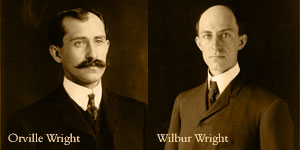
plane with which Orville and Wilbur Wright made
their historic first flights on December 17, 1903
has been built with over $1 million donated by
Combs. The
plane will be dedicated in a ceremony on December
17, 2003 -- one hundred years to the day that the
Wright brothers made the first manned, powered,
controlled, sustained flights. Joining Harry Combs
for the special dedication ceremony at 1 p.m. on
the Main Stage will be Apollo XI astronaut Neil
Armstrong and Senator Ted Stevens (R-Alaska), both
long-time friends of Combs.
The flyer will then be on
permanent display at the Visitor Center at Wright
Brothers National Memorial in Kill Devil Hills,
N.C.
“We are extraordinarily
grateful to Harry Combs for this generous gift to
the American people,” Secretary of the Interior
Gale A. Norton said.
“The Wright Flyer serves as an important
reminder of a remarkable benchmark in our
nation’s aviation history, which inspires people
all over the world.”
Planning for the construction
of the reproduction started in January 2002 to
ensure its readiness for the 100th anniversary of
flight. The
Wright Experience of Warrenton, VA, has built the
flyer using reverse engineering based on the
Wright brothers’ writings, letters and
photographs.
Harry Combs is a noted
aviator, historian, author and businessman. The
Colorado native, who passed away on December 27,
2003, has personally
lived and breathed the Golden and Jet Ages of
aviation.
He saw his first airplane at
the age of four-and-a-half.
As a young boy in school, Combs was
spellbound while reading Diary of an Unknown
Aviator, the renowned World War I chronicle by
Elliot White Springs. Combs’ father, Albert, was
shot down twice in that war, and admonished his
son never to set foot in an airplane.
Undaunted, the determined young Combs paid
$2.50 for a ride in a mail plane at the age of 13;
then, two years later, inspired by an
advertisement for $99 flying lessons, made his way
to St. Louis, MO for three hours of flight
instruction and immediately soloed thereafter. He
helped design, build and flight-test his first
airplane, Vamp Bat, a sport biplane, at age 16.
After graduating from Yale
University with a degree in applied economics,
Combs worked a short stint with Pan American
Airways; ran a small flying service in Armonk, NY;
dabbled in investment banking and served as a
second lieutenant pilot officer for the Colorado
National Guard where he quickly logged enough
flying time to earn an instructor’s rating. In
1938, Combs, then 25, founded Mountain States
Aviation, a fixed-base operation that later became
Combs Aircraft.
During World War II his company turned out
9,000 military aviators.
In addition to training pilots, Combs
joined the U.S. Army Air Force Air Transport
Command and flew C-54 troop transports over the
North Atlantic, Africa and India.
Following the war, Combs
Aircraft became one of the largest and most
successful networks of aircraft sales and service
centers in the country.
The business practices Harry Combs created
are now accepted industry standards.
In 1961, President John F.
Kennedy appointed Combs to Project Beacon, a
special task force that modernized the nation’s
air traffic control system. Many of Combs’
initial concepts are still used in air traffic
control today. He also served as a technical
advisor to NASA in the early stages of the
national space program. As president of Gates
Learjet Corporation from 1971 to 1982, Combs
guided the jet manufacturer to new heights in
corporate aviation, and further left his mark on
the aviation industry through his efforts to
promote flying safety.
Under his direction, the Learjet became the
first U.S. civil aircraft to be FAA-approved for
normal cruise at 51,000 feet. It was also the first plane to use NASA’s thrust-enhancing
“winglet” technology, a feature widely used on
modern-day aircraft.
Combs has received numerous
honors and awards for his work in aviation,
including the Wright Brothers Memorial Trophy; the
National Aeronautic Association’s “Elder
Statesman of Aviation” award; the FAA’s
Distinguished Service Award for leadership in
promoting flight safety; The Wings Club’s
Distinguished Achievement Award for contributions
to the development of the aviation industry; and
General Aviation Man of the Year. Combs is an
honorary member of the Lafayette Flying Corps and
has been inducted into the National Aviation Hall
of Fame, and the Colorado and Arizona Aviation
Halls of Fame.
Combs’ own realization of
the Wright brothers’ genius came later in his
life. Studying
their papers ignited a passion in Combs, and a
dedication to share their story. His noted work on
the Wright brothers, “Kill Devil Hill:
Discovering the Secret of the Wright Brothers”,
won the James J. Strebig Memorial Trophy, the
Aviation/Space Writers Association’s highest
award for excellence in aviation writing.
Combs also produced an educational video,
“How Strong is the Wind?” based on his book,
which has been widely praised for illuminating
little known facts about the Wrights.
Combs’ donation of the
reproduction of the Wright Flyer furthers his
mission to educate and enlighten others to the
great contribution made to mankind by the Wright
brothers.
|