The Douglas DC-3 was the 1930s airliner that made scheduled passenger service pay for itself, then became the C-47 Skytrain that carried a war across continents. The DC-3 plane could cross the United States from New York to Los Angeles in 18 hours with three stops, use short grass or dirt strips, and seat far more people than the aircraft it displaced. Those practical advantages explain why its outline still appears at airshows, in remote cargo work, and in some of aviation history’s most consequential photographs.
What made the DC-3 plane the airliner that changed travel?
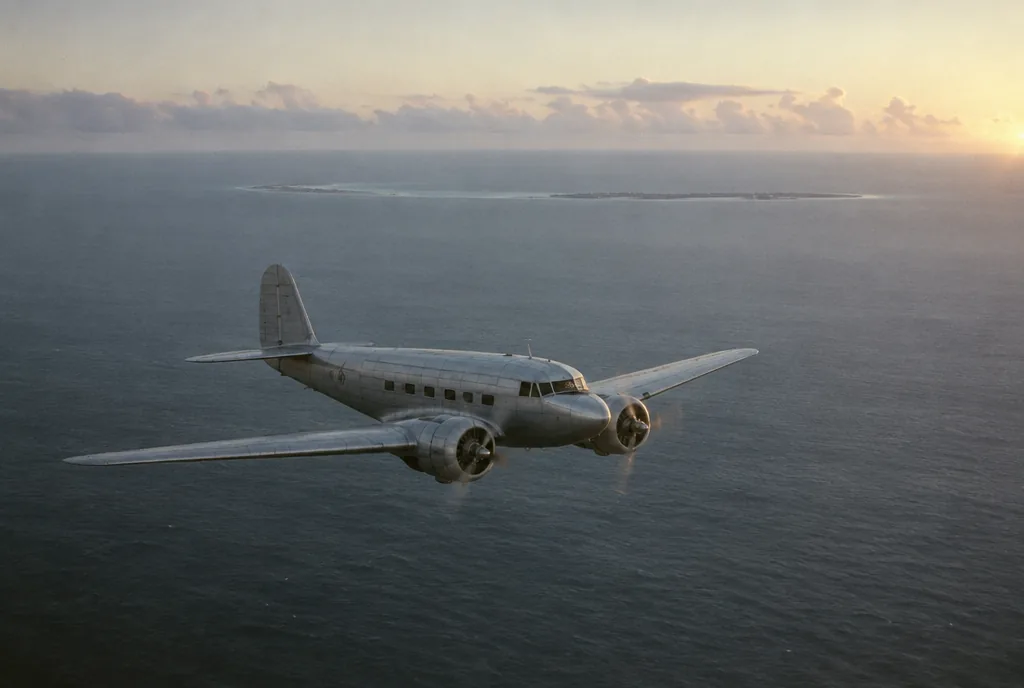
The DC-3 was a twin-engine, low-wing monoplane with a twin tail. It measured 64 feet 5 inches long and had a 95-foot wingspan, proportions that gave it a purposeful silhouette without making it too large for the airfields of its day. Two 14-cylinder Pratt & Whitney R-1830 Twin Wasp radial engines, each rated at 1,200 horsepower, powered the airplane. Its 207-mph cruising speed and 237-mph maximum speed put long-distance travel on a schedule that passengers could use.
Its importance was not simply speed. With standard fuel, the DC-3 had a range of about 1,500 miles and a service ceiling between 23,200 and 24,000 feet. It could also take off and land on short, unpaved grass and dirt runways. That combination made the airplane useful on routes where an airline needed more than an elegant city-to-city machine: it needed an aircraft that could keep moving when the airport was modest and the route was long.
By 1939, about 90 percent of airline flights worldwide were flown by a DC-3 or one of its derivatives. The statistic captures a change in scale rather than a passing fashion. The DC-3 carried 21 passengers in its common configuration, compared with 14 in the preceding DC-2, while also taking more baggage. Lower operating cost per seat-mile gave airlines a more workable business model, and passengers received a service that made rail and road travel look slower on the longest routes.
How a sleeper aircraft became American Airlines’ moneymaker
The story began with a request for more comfort. American Airlines chief executive C. R. Smith and Douglas chief engineer Arthur Raymond worked through the requirements in a marathon telephone conference. The resulting prototype was the Douglas Sleeper Transport, or DST, construction number 1494 and registered NX14988. It first flew from Clover Field in Santa Monica, California, on December 17, 1935, with Douglas vice president and chief test pilot Carl A. Cover at the controls, exactly 32 years after the Wright brothers’ first flight.
The DST treated night travel as an experience to be designed. It offered 14 sleeping berths for overnight flights and could carry 28 daytime passengers. A 21-seat version became the standard DC-3 arrangement. In June 1936, American Airlines received the first DST in service, named Flagship Texas. On June 25, 1936, the airline operated the first scheduled DC-3 passenger flight: Flagship Illinois flew nonstop from Chicago to Newark.
| Aircraft or version | Passenger arrangement | What it changed |
|---|---|---|
| Douglas DC-2 | 14 passengers | The capacity benchmark the DC-3 surpassed |
| Douglas Sleeper Transport | 14 berths or 28 daytime passengers | Put overnight comfort at the center of the design |
| Standard civil DC-3 | Usually 21 passengers | Lowered cost per seat-mile while adding baggage capacity |
| C-47 Skytrain | 28 equipped paratroopers | Turned the basic airframe into a military transport |
The financial result was as striking as the cabin change. The DC-3 became the first passenger aircraft that could operate profitably on passenger revenue alone, without mail subsidies. Smith put the point bluntly: it was the first airplane that could make money “just by hauling passengers.” The phrase matters because it describes a structural shift in air travel. An airline could now build schedules around people buying tickets, not around a subsidy that made the route possible.
On the United States’ longest headline route, the airplane could travel from New York to Los Angeles in 18 hours with only three intermediate stops; the eastbound trip took about 15 hours. It could not fly the route nonstop before World War II, but it made the continent an airline itinerary rather than a sequence of disconnected local flights. Civil DC-3 production ended after only 607 aircraft in 1942–43 when Douglas turned its factories to military work. The design’s wider story was only beginning.
Why the DC-3 worked where other airliners could not
The figures explain only part of the aircraft’s durability. A 1,500-mile range, a 207-mph cruise, and the ability to operate from rough strips made the DC-3 adaptable to places with limited infrastructure. Its wing’s leading edge had 15.5 degrees of sweep, while the outer wings carried 5 degrees of dihedral. Those are small design details in a large story: the aircraft was engineered as a complete working tool, not merely as a faster passenger cabin.
Cabin layouts could change with the work. Civil DC-3s carried between 21 and 32 passengers depending on seating, and the most common civil arrangement had 21 seats and seven windows. A rarer 24-passenger version had eight windows. The DST’s 14 berths show how far the same family could stretch in the other direction, toward overnight accommodation rather than maximum daytime capacity.
That flexibility created an enduring reputation. “The only replacement for a DC-3 is another DC-3” became an aviation saying because operators kept finding jobs that suited the aircraft. It did not mean the machine was immune to cost. Annual maintenance for a flying DC-3 has been estimated at about £100,000, roughly €115,000. Yet spares have remained comparatively obtainable because more members of the DC-3 family were built than all other airliners of their era combined.
Why the C-47 Skytrain was not simply a military DC-3
A C-47 Skytrain is related to a DC-3, but the names are not interchangeable. The C-47 was the military version of the civil design, altered for work that an airline cabin could not do. It had a cargo door, a reinforced floor, a hoist, and a shortened tail cone for glider-tow cables. An astrodome in the cabin roof aided navigation, and the aircraft received a more powerful engine.
Those changes changed what the airplane could carry. A C-47 could transport 28 fully equipped paratroopers or 6,000 pounds of cargo. In medical evacuation service, it could hold 14 litters with medical attendants. The numbers place the military aircraft alongside the civil DC-3 without erasing the difference: one was organized around paying passengers; the other was organized around people, cargo, casualties, and equipment moving under wartime demands.
Production tells the same story. In all, 10,174 C-47s were built, while total production across civil DC-3s, military C-47s, Soviet Lisunov Li-2s, and Japanese Nakajima L2Ds exceeded 16,000 aircraft. The Royal Air Force called the C-47 the Dakota. In 1944 alone, production of the DC-3/C-47 family reached 4,853 deliveries, a yearly total that shows how completely the design had moved from commercial innovation to wartime necessity.
How the C-47 carried D-Day into the dark
In the early hours of June 6, 1944, the DC-3 family’s military role became impossible to miss. More than 1,000 C-47 Dakotas crossed toward Normandy, 1,087 of them from the USAAF alone. They dropped more than 13,000 U.S. paratroopers from the 82nd and 101st Airborne Divisions. The image is often reduced to a row of aircraft against the night sky, but the operational fact is more demanding: the transports had to deliver thousands of soldiers at the opening of the invasion.
Normandy was one chapter in a much wider service record. C-47s flew missions in Guadalcanal, New Guinea, Burma, Sicily, southern France, the Netherlands during Market Garden, and the Ruhr region. They formed the backbone of Allied transport operations because the same basic airplane could deliver troops, haul supplies, evacuate wounded personnel, and tow gliders when the mission changed.
After the war, C-47s and DC-3s carried coal, food, and relief supplies into West Berlin during the 1948–49 Berlin Airlift. In that operation they earned the nickname Rosinenbomber, or “raisin bombers.” The name can sound lighthearted, but it belongs to a supply effort in which an aircraft developed for commercial comfort was used to sustain a city.
Why DC-3s still fly decades after their first flight
Yes, DC-3s and C-47 variants are still flying. Estimates place the worldwide airworthy population at about 150 to 200 aircraft, with 50 to 100 in regular operation. Early in 2024, the Royal Aeronautical Society counted about 172 DC-3s of all variants in commercial operation; roughly one-third were turboprop conversions. The figures are estimates and snapshots, but they show that this is not merely a museum story.
The aircraft’s unpressurized fuselage helps explain the longevity. Without repeated pressurization cycles, the structure does not face the same fatigue mechanism found in pressurized airliners. Age still brings demanding maintenance, but the basic airframe has a reason to survive. The former American Airlines Flagship Detroit, construction number 1920 and the 43rd aircraft off the line, was delivered on March 2, 1937, and is one of the oldest DC-3s still flying.
Modern work has also kept the design relevant. The Basler BT-67 is a deep conversion of a DC-3 or C-47 by Basler Turbo Conversions in Oshkosh, Wisconsin. It receives two Pratt & Whitney Canada PT6A-67R turboprops rated at 1,424 horsepower each, a fuselage stretch of 3 feet 3 inches, and a digital glass cockpit. About 90 percent of the original structure is replaced in the process, and the FAA certifies the BT-67 as its own type with a separate type rating.
That is not a cosmetic update. BT-67s are used for Antarctic research, cargo work in Alaska and Canada, and by military organizations including U.S. Air Force Special Operations. The conversion preserves the reason the older airframe mattered, its ability to operate in difficult places, while exchanging its original piston engines and cockpit for a substantially rebuilt aircraft.
What the DC-3 can and cannot do across the Atlantic
A standard DC-3(a), with a range of roughly 1,500 miles, does not have the reserves for a nonstop Atlantic crossing. That limitation is worth stating plainly because the aircraft’s long service can make it seem capable of any distance. The same limitation meant that, before World War II, it could not fly nonstop from New York to Los Angeles and needed three stops.
With additional ferry tanks, however, a DC-3 can make an Atlantic ferry flight. Military aircraft crossed the Atlantic regularly during the war, and some sources give a maximum range of up to 3,500 kilometers, about 1,890 nautical miles, with extra tanks. A ferry crossing is therefore not evidence that the standard aircraft was designed for a nonstop transatlantic passenger route. It is a specialized operation built around additional fuel and route planning.
The famous wreck on Iceland’s Sólheimasandur beach needs a similar distinction. It is often called a “DC-3 plane wreck,” but the aircraft was a U.S. Navy Douglas C-117D, a Super-DC-3 also designated R4D-8. At about 2 p.m. on November 21, 1973, it made an emergency landing on the black sand while flying a supply mission from Höfn to Stokksnes. Severe icing caused engine failure; all seven crew members survived uninjured, and the aircraft was written off. The wreck remains on the beach, reached by a four-kilometer walk from the nearest road.
Three DC-3 myths that miss the real story
Myth: A C-47 and a DC-3 are exactly the same airplane
They share an ancestry, but the C-47’s cargo door, reinforced floor, hoist, tail-cone modification, astrodome, and military transport role make it a distinct version. Calling every surviving transport a DC-3 blurs the changes that enabled it to carry 6,000 pounds of cargo or 28 equipped paratroopers.
Myth: The Iceland wreck is an ordinary DC-3
The 1973 Sólheimasandur aircraft was a Navy C-117D Super-DC-3. It is connected to the family, but the more precise name preserves what visitors are actually seeing and why the wreck’s story belongs to military supply flying rather than a routine airline service.
Myth: Long life means a DC-3 is cheap or simple to operate
The remaining fleet demonstrates a robust design, not effortless upkeep. A flying DC-3 can require roughly £100,000 in annual maintenance, even though parts remain comparatively available. Its long life is the result of continuing specialist care as much as sound 1930s engineering.
Frequently Asked Questions
What is a DC-3 plane?
The Douglas DC-3 is a twin-engine, low-wing passenger aircraft that first flew on December 17, 1935. It became the first airliner able to operate profitably on passenger revenue alone and later provided the basis for the military C-47 Skytrain.
How many passengers can a DC-3 carry?
A DC-3 can carry 21 to 32 passengers depending on the seating layout. The most common civil arrangement had 21 seats, while the earlier Douglas Sleeper Transport had 14 berths for night flights and room for 28 daytime passengers.
Is a DC-3 the same as a C-47?
No. The C-47 is the military version of the DC-3, modified with features including a cargo door, reinforced floor, hoist, shortened tail cone, and astrodome. It could carry 28 equipped paratroopers or 6,000 pounds of cargo.
Are any DC-3 planes still flying?
Yes. Estimates put 150 to 200 DC-3/C-47 variants worldwide in airworthy condition, with 50 to 100 in regular operation. The Flagship Detroit, delivered in 1937, is one of the oldest DC-3s still flying.
Can a DC-3 fly across the Atlantic?
A standard DC-3 does not have enough range and reserve fuel for a nonstop Atlantic crossing. With ferry tanks, however, aircraft of the type can make ferry flights across the Atlantic; military examples crossed regularly during World War II.