The Concorde plane carried paying passengers across the Atlantic at more than twice the speed of sound. At Mach 2.04, it turned a London–New York trip into a journey of under three and a half hours, yet that performance depended on a tiny fleet, expensive engineering, and routes constrained by the sonic boom.
How a British-French agreement built an unlikely airliner
Concorde began with a bilateral treaty signed by Britain and France in November 1962. Sud Aviation, later Aerospatiale, worked with the British Aircraft Corporation on a civil airliner unlike anything then in service. Its name, chosen by French President Charles de Gaulle in a 1963 speech, meant “harmony” or “agreement” in French.
The scale of the ambition was clear long before the aircraft carried a passenger. In 1962, the program was estimated at £70 million; by 1976, the total had grown to between £1.5 billion and £2.1 billion. At the first flight, 74 options from 16 airlines appeared to promise an international market. In the end, only British Airways and Air France operated Concorde commercially.
Prototype 001 made its maiden flight from Toulouse on March 2, 1969. French test pilot André Turcat kept the 27-minute flight to 10,000 feet and 300 mph, a cautious beginning for an aircraft intended to fly far faster. The British prototype followed from Filton near Bristol on April 9. On its 45th test flight, October 1, 1969, Concorde passed the sound barrier for the first time, reaching Mach 1.5 and remaining supersonic for nine minutes.
Only 20 Concordes were built: two prototypes, two pre-production aircraft, two development aircraft, and 14 production models. That small number would later shape the airplane’s economics as decisively as its speed did.
Concorde speed made the Atlantic feel smaller
At cruise, Concorde flew at Mach 2.04, or 1,354 mph, at 55,000 to 60,000 feet. Subsonic airliners normally cruise below 44,000 feet. In practice, a typical London–New York crossing took less than 3.5 hours, compared with roughly eight hours on a subsonic flight.
British Airways set the commercial-aircraft transatlantic record on February 7, 1996. Its Concorde flew from New York JFK to London Heathrow, a distance of 6,035 kilometers (3,750 miles), in 2 hours, 52 minutes, and 59 seconds. The average speed exceeded 2,011 km/h.
| Measure | Concorde figure | Why it mattered |
|---|---|---|
| Cruise speed | Mach 2.04 / 1,354 mph | It made a same-day transatlantic business trip possible in a way conventional service could not. |
| Cruise altitude | 55,000–60,000 feet | It flew above the usual cruising levels of subsonic airliners. |
| London–New York time | Under 3.5 hours | A comparable subsonic trip took about eight hours. |
| JFK–Heathrow record | 2:52:59 | It remains the fastest commercial-aircraft crossing of the Atlantic. |
Speed also imposed a geographic limit. Concorde could not fly supersonic over land in the United States or most other countries because of the sonic boom. Its natural stage was therefore an ocean route, where it could accelerate after departure and slow before reaching land.
The Concorde jet had to manage heat, fuel, and high speeds
Four Rolls-Royce/SNECMA Olympus 593 Mk 610 turbojet engines powered Concorde. With reheat, also called afterburner, each produced 38,050 pounds of thrust at takeoff. The aircraft needed that force: its takeoff speed was 250 mph and its landing speed was 187 mph, both high figures linked to its delta-wing design.
At Mach 2, the air itself became an engineering problem. Friction heated the nose tip to 260°F, and the airframe stretched by 6 to 10 inches in flight. Concorde used fuel as a heat sink for cabin air conditioning and hydraulics. Its fuel use in cruise was about 25,629 liters per hour across all four engines, an indication of why extraordinary speed did not translate into ordinary airline economics.
The aircraft’s ogival delta wing and lack of a tail made it visually distinctive. At rotation, its nose rose to an angle of attack of about 18 degrees. It also used an early digital engine-control system to adjust variable intake ramps and prevent engine surges at Mach 2. These details explain why Concorde was not simply a faster version of a conventional jet.
The Concorde plane interior made time the luxury
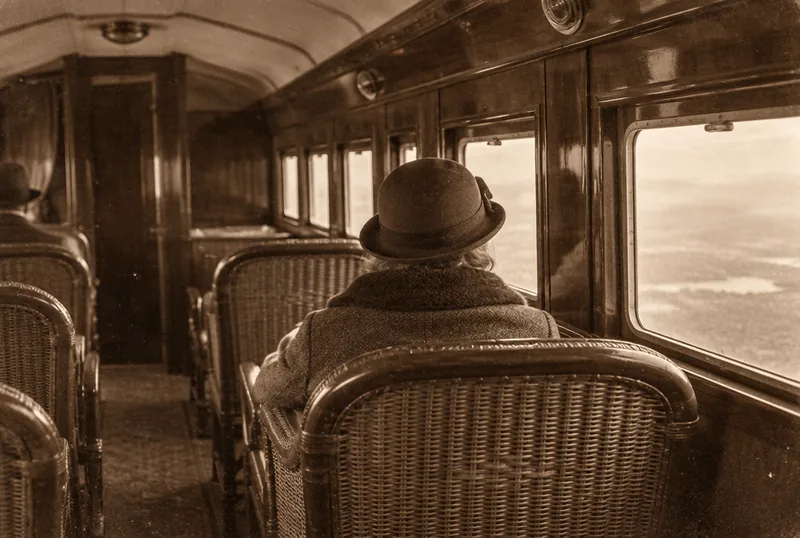
Concorde’s cabin was only 8 feet 8 inches wide. Seating was arranged 2+2 around a single aisle, with room for 100 to 128 passengers. British Airways used 40 seats in the front section and 60 in the rear. That layout made the interior intimate, but it did not make it roomy.
Headroom was limited compared with a wide-body airliner, the windows were small, and overhead storage was minimal. The luxury lay in arriving hours earlier and in the service, not in personal space. The narrow fuselage even flexed in flight; passengers in the rear could perceive it by looking down the cabin’s length.
That tradeoff puts Concorde’s high fares in context. In 1996, a British Airways round-trip ticket from New York to London cost $7,574. In September 2003, a one-way London–New York ticket cost £4,350. Passengers bought scarce time on an aircraft that seated only 100 people in British Airways configuration.
Routes proved the appeal of supersonic passenger flight
Commercial service began on January 21, 1976. British Airways flew from London Heathrow to Bahrain, while Air France flew from Paris to Rio de Janeiro. A joint Singapore Airlines/British Airways service later connected London and Singapore via Bahrain from 1977 to 1980.
By the late 1990s, New York JFK was the only regular scheduled Concorde destination for both airlines: British Airways from London and Air France from Paris. The route concentrated the airplane’s appeal, fast travel between two major financial centers, but it also exposed the fleet to a narrow market. A supersonic airliner that could not cross populated land at supersonic speed had far fewer viable routes than a conventional long-haul aircraft.
The Concorde plane crash exposed a catastrophic chain of events
On July 25, 2000, Air France Flight 4590, Concorde F-BTSC, crashed shortly after takeoff from Charles de Gaulle Airport at Gonesse, France. All 100 passengers and nine crew members died, along with four people on the ground. It was the only fatal Concorde accident.
The investigation identified a precise sequence during the takeoff roll on runway 26R. The front right tire of the left landing gear ran over a 43.5-centimeter titanium-alloy wear strip that had fallen from a Continental Airlines DC-10 minutes earlier. The strip cut tire No. 2. Debris struck the wing at high speed, rupturing fuel tank 5 and tearing a hole of about 0.5 square meters through the upper wing surface.
A massive kerosene leak ignited. Engines 1 and 2 lost thrust when the aircraft was already at rotation speed and too fast to abort. The accident grounded the entire fleet. Service resumed on November 7, 2001, after modifications that included Kevlar fuel-tank liners, burst-resistant tires, and more secure electrical controls.
Why Concorde was retired: more than one accident
The crash was the direct trigger for grounding and costly modifications, and it damaged the aircraft’s reputation. It was not, however, the sole reason Concorde stopped flying. After the September 11, 2001, attacks, demand for premium air travel declined. At the same time, maintenance costs rose and Airbus decided it would no longer supply replacement parts for the fleet of only 20 aircraft.
British Airways recorded £84 million in Concorde write-off costs for the financial year ending in March 2003. Air France flew its final commercial service on May 30, 2003. British Airways’ last commercial flight, BA002 from JFK to Heathrow, landed on October 24, 2003. The final flight of any kind came on November 26, when G-BOAF flew from Heathrow to Bristol Filton for museum preservation before a crowd of more than 20,000.
Two Concorde myths worth leaving behind
- “It was retired only because it crashed.” The accident mattered, but retirement followed a convergence of costly maintenance, reduced premium-travel demand, and the end of replacement-parts support.
- “Its cabin was the luxury.” The cabin was narrow, with small windows and limited storage. The defining luxury was speed: hours saved across the Atlantic.
Frequently Asked Questions
Why did they stop flying Concorde?
British Airways and Air France retired Concorde in 2003 after maintenance costs rose, premium travel declined after 9/11, and Airbus ended replacement-parts supply for the very small fleet. The 2000 crash and the required modifications added to the pressure.
How much did a ticket on Concorde cost?
A 1996 British Airways round-trip ticket between New York and London cost $7,574. In September 2003, a one-way London–New York ticket cost £4,350.
Do Concorde planes still exist?
Yes. Eighteen of the 20 built survive, and 16 are on public display. In the United States, examples are at the Intrepid Sea, Air & Space Museum in New York City, The Museum of Flight in Seattle, and the Smithsonian’s Udvar-Hazy Center near Washington, DC.
Why did the Concorde crash?
Flight 4590 ran over a titanium strip on the runway, which cut a tire. Tire debris ruptured a fuel tank, fuel ignited, and two engines lost thrust after the aircraft had reached a speed too high to abort takeoff.
How fast was the Concorde plane?
Concorde cruised at Mach 2.04, or 1,354 mph, at 55,000 to 60,000 feet. A typical London–New York crossing took under three and a half hours.