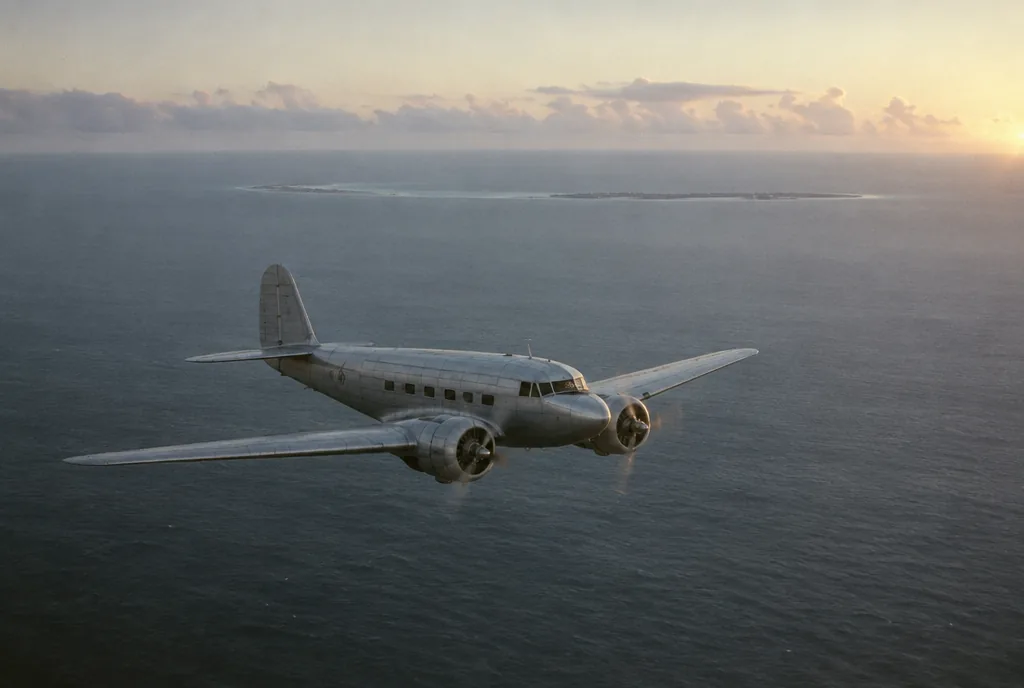
A boat plane, more properly called a flying boat, is an aircraft whose own fuselage is a watertight hull: it floats, takes off, and lands directly on water. That simple design let aviation reach coastlines, islands, and harbors before the world had long paved runways. It also produced some of the most ambitious machines of the 20th century, from the Curtiss NC-4’s 1919 Atlantic crossing to Pan Am’s ocean-spanning Clippers and the enormous Hughes H-4 Hercules.
What a Boat Plane Is—and Why Its Hull Matters
“Seaplane” is the broad category for aircraft that operate from water, but the term does not describe one construction method. In a flying boat, buoyancy comes from the fuselage itself. Its boat-shaped hull supports the airplane on the water, so the aircraft has no conventional landing gear and uses the surface as its landing area.
That hull had to do two jobs. In the air it was an aircraft fuselage; on the water it had to support the entire machine. Typically, flying-boat hulls used a V-shaped, semi-planing or planing form. On the underside, a step—the abrupt change in cross-section—helped break the suction that otherwise held the hull to the water during takeoff. This small feature had a big consequence: without separating cleanly from the surface, a large aircraft could not accelerate into flight.
The arrangement also explains why the biggest seaplanes were flying boats rather than floatplanes. A hull spreads weight and buoyancy along the body of the aircraft. External pontoons impose a practical size limit, while the sea offered a takeoff run far longer than the grass airfields available to early landplanes. For much of the 1930s and 1940s, the result was startling: the world’s largest aircraft were often designed to fly from water.
Flying Boat, Floatplane, or Amphibian? The Difference Is Structural
A floatplane has a conventional fuselage held above the water on two or more separate pontoon floats bolted beneath it. That fuselage never touches the water. In a flying boat, the relationship reverses: the hull is the float. With retractable wheels, either a flying boat or a floatplane can become an amphibian able to use water and paved runways.
| Type | What floats | Where it can operate |
|---|---|---|
| Flying boat | The boat-shaped fuselage or hull | Water; some designs become amphibians with retractable wheels |
| Floatplane | Separate external pontoons beneath a conventional fuselage | Water |
| Amphibian | A flying-boat hull or floats, plus retractable wheels | Water and paved runways |
The terms matter because appearances can mislead. Not every seaplane is a flying boat; “seaplane” is the umbrella term, although in some countries it is also used to mean a floatplane. An amphibian is not a separate family; it is a capability added to a flying boat or floatplane.
Before Global Runways, Harbors Became Aviation’s Gateways
In a world where aviation infrastructure was scarce, flying boats made sense. Before World War II, Floyd Bennett Field in New York, completed in 1930, was the only concrete runway in the entire United States. Elsewhere, grass fields limited the size and reliability of landplane operations. Yet the major cities of the world were often coastal cities with harbors. A protected stretch of water could serve as a landing area without anyone first building a long runway.
In the 1930s, that geographical advantage made flying boats central to long-distance international travel. Harbors already connected ships, mail, customs services, and travelers; a flying boat could use the same waterfront logic. By 1939, flying boats dominated long-distance international air travel, and Pan Am operated routes across the Atlantic, Pacific, and Caribbean.
The appeal was practical, not just romantic. Where no long land runway existed yet, a water route could still join places. The limitation was just as clear: every route depended on water conditions and suitable harbor facilities. When the runway network expanded worldwide, that same connection to the sea would leave flying boats exposed.
The NC-4 and the Do X Showed What Waterborne Flight Could Attempt
The Curtiss NC-4 crossed the Atlantic in stages
The Curtiss NC-4 showed that an early flying boat could take on an ocean. Built by the Curtiss Aeroplane and Motor Company, the four-engined aircraft carried a name that joined Navy (N) and Curtiss (C). Its hull came from the Herreshoff Manufacturing Corporation of Bristol, Rhode Island, a builder known for racing yachts. For an aircraft meant to live on the water, that pedigree suited the task.
On May 16, 1919, three Curtiss NC flying boats—NC-1, NC-3, and NC-4—left Newfoundland. Only NC-4 completed the crossing to the Azores and then Lisbon. Its route from New York State to Lisbon took 19 days and multiple stops, making it the first aircraft of any kind to cross the Atlantic. Power came from four Liberty L-12 V-12 water-cooled piston engines, each rated at 400 horsepower (300 kW). It was no nonstop sprint; the achievement demonstrated that a carefully staged water route could connect continents.
The Dornier Do X made sheer scale the headline
A decade later, the German Dornier Do X made a different argument. At its maiden flight on July 12, 1929, it was the largest, heaviest, and most powerful aircraft in the world. It had a 48.0-meter (157-foot 6-inch) wingspan, 40.1-meter (131-foot 7-inch) length, and 52,000-kilogram (114,640-pound) maximum takeoff weight. Twelve engines sat above the wing in tandem nacelles, first Siemens-Jupiter radials rated at 525 horsepower each and later Curtiss Conqueror V-12s.
On August 21, 1930, the Do X carried 169 paying passengers on a promotional flight, a passenger record that stood for decades. Yet only three airframes were built; the giant was never a production program. A record-breaking flying boat and a commercially repeatable design were not the same thing.
Pan Am Clippers Made Transoceanic Travel a Scheduled Experience
Pan Am named its long-range flying boats “Clipper,” a trademark evoking the fast sailing clipper ships of the 19th century. The comparison was deliberate. Across oceans and island stops, these aircraft followed old maritime geography while offering scheduled air travel.
The China Clipper route came first
Before the Boeing 314, Pan Am used the Martin M-130. On November 22, 1935, the type began transpacific mail service from San Francisco to Manila, a route known as the China Clipper service. Just three M-130s were built. At a cruising speed of 255 kilometers per hour (158 mph), they carried 36 passengers over a range of 5,150 kilometers (3,200 miles). Those figures show both the breakthrough and the constraint: the Pacific could be linked by air, but long-distance travel still required a purpose-built aircraft and a chain of suitable stops.
The Boeing 314 turned the cabin into an ocean liner’s interior
Between 1938 and 1941, Boeing built just 12 Model 314 Clippers. Each had four Wright R-2600 Twin Cyclone radial engines rated at 1,600 horsepower (1,200 kW) each, a 46.3-meter (152-foot) wingspan, and a maximum range of 5,960 kilometers (3,700 miles), enough for Atlantic and Pacific crossings with fuel reserves. In sleeper configuration, capacity was 40 passengers; by day, it reached 74.
Pan Am flew the 314 on scheduled routes from New York to Southampton and to Lisbon, and on transoceanic services to the Philippines, Guam, Australia, and New Zealand. Inside, the cabin included a full-service dining room, galley, and separate men’s and women’s dressing rooms. On June 28, 1939, Yankee Clipper began Pan Am’s first transatlantic passenger service, flying from New York to Marseille via the Azores. At about $375 one way from New York to Southampton in 1939, the service was elite.
Imperial Airways built a parallel flying-boat network
Arthur Gouge designed the four-engined Short S.23 Empire for Imperial Airways to link Britain with South Africa, Singapore, and Australia. The first S.23, Canopus, flew on July 3, 1936, and entered service that September. In all, 42 Short Empire flying boats were built: 31 S.23s, nine S.30s, and two S.33s. An S.23 could carry 24 daytime passengers or 16 sleeping passengers plus 1.5 tons of mail. Imperial Airways ordered 28 flying boats in 1935, before a design even existed; the British press called it one of the world’s boldest experiments in aviation.
World War II Turned the Flying Boat into a Patrol Workhorse
War opened another chapter in seaplane history. The Consolidated PBY Catalina first flew on March 28, 1935, entered U.S. Navy service in October 1936, and became the most widely used seaplane of World War II. Total production reached 3,305 aircraft: 2,661 built in the United States, 620 in Canada, and 24 in the Soviet Union. In Canadian service, it was called the Canso.
Catalinas served in every theater with every branch of the U.S. armed forces as well as the RAF, RCAF, RAAF, Soviet Navy, and many other Allied forces. Their long-range patrols closed the Mid-Atlantic Gap, where U-boats had operated with impunity. On June 4, 1942, a Catalina spotted the Japanese fleet approaching Midway, reported “Many planes heading Midway,” and later sighted the carriers.
The design evolved over time. After the PBY-1 (60 built) came variants with longer range and heavier armament; the PBY-5A added amphibious landing gear. The Martin PBM Mariner was designed as a twin-engine patrol bomber to complement the Catalina. Between 1940 and 1949, 1,366 Mariners were built. It had a 35.97-meter (118-foot) wingspan, a 340 km/h (211 mph) maximum speed, and a 4,800-kilometer (2,980-mile) range.
Why the Runway Network Ended the Great Flying-Boat Era
World War II brought the change that peacetime aviation had lacked: runways on a global scale. Across Pacific islands, Europe, North Africa, and Asia, the U.S. Navy Sea Bees and the U.S. Army Corps of Engineers built hundreds of concrete and asphalt runways for military logistics. Once those hard surfaces existed, long-distance landplanes no longer needed harbor infrastructure to reach the same regions.
Fast landplanes such as the Douglas DC-4 and Lockheed Constellation could now fly the long routes that had once needed flying boats. Between 1942 and 1945, U.S. factories alone produced 354,750 aircraft. That huge investment in landplane manufacturing and airfield construction made flying boats economically uncompetitive. By 1950, the Boeing 314 was obsolete, and in 1951 the last surviving Clipper sank in Baltimore harbor.
The military transition took longer but pointed the same way. The U.S. Navy continued operating flying boats into the 1960s, including the Martin PBM Mariner and P5M Marlin. The last Martin Mars flying boats left Navy service in 1956. The disappearance of the big passenger flying boat was therefore not a failure of the hull concept; it was the result of a world remade around paved runways.
Flying Boats Still Have Jobs Where Water Is the Better Airfield
Flying boats did not vanish completely. They survive in specialized work where water access matters more than airline-scale passenger capacity. The Beriev Be-200 is a twin-jet amphibious flying boat used for firefighting; it can scoop 12 tons of water in 14 seconds. The ShinMaywa US-2 is a four-turboprop STOL amphibious flying boat used by the Japan Maritime Self-Defense Force for search and rescue and can operate in sea state 5, with waves from 2.5 to 4 meters.
The Martin JRM Mars shows how an older flying-boat design could find a later purpose. Originally a World War II transport, it was converted into a water bomber. Only six Mars aircraft were built for the U.S. Navy; four survived into the 1960s and were converted to civilian water bombers. The Philippine Mars was capable of dropping 7,200 U.S. gallons (27,250 liters) of water.
Remote regions also keep the broader seaplane tradition alive. Small floatplanes and amphibians remain useful in Alaska, Canada, and the Maldives, where landing on water can be faster and less costly than building a runway. The modern flying boat is no longer the standard vehicle for crossing an ocean, but it can still go where a runway is absent—or where a lake or coastline is the point of access.
Two Flying-Boat Myths That Miss the Real Story
“Every seaplane is a flying boat.”
No. A seaplane can be a flying boat or a floatplane. The visual test is simple: if the fuselage itself is the floating hull, it is a flying boat; if the fuselage sits above separate pontoons, it is a floatplane. An amphibian adds retractable wheels and may be based on either arrangement.
“The Spruce Goose was made of spruce and never really flew.”
The Hughes H-4 Hercules was built almost entirely of birch plywood, not spruce, using the Duramold process because World War II restrictions limited aluminum use. It was the largest seaplane ever built, with a 97.5-meter (320-foot) wingspan. Designed to carry 750 troops or two 30-ton M4 Sherman tanks, it flew once on November 2, 1947, with Howard Hughes at the controls: about 1.6 kilometers (1 mile) at an altitude of 21 meters (70 feet). One flight does not make it an operational transport, but it does make “never flew” inaccurate.
Frequently Asked Questions
What is a flying boat?
A flying boat is a seaplane with a boat-shaped fuselage that acts as its floating hull. It takes off and lands directly on water, rather than resting on external pontoons.
What is the difference between a flying boat and a floatplane?
A flying boat’s fuselage provides buoyancy and touches the water. A floatplane has a conventional fuselage above two or more external floats. Both belong to the wider seaplane category.
Why did flying boats disappear from passenger service?
World War II created hundreds of hard-surface runways worldwide and accelerated landplane production. With routes and airfields available, aircraft such as the DC-4 and Lockheed Constellation made large flying boats economically uncompetitive.
What were the Pan Am Clippers?
Pan Am used the trademark “Clipper” for its long-range flying boats, including the Martin M-130 and Boeing 314. The Boeing 314 carried up to 74 daytime passengers and flew scheduled services across the Atlantic and Pacific.
Are flying boats still used today?
Yes, in niche roles. The Be-200 works as an amphibious firefighting aircraft, and Japan’s US-2 performs search-and-rescue work. Small seaplanes and amphibians also remain practical in remote regions without convenient runways.