The Supermarine Spitfire became Britain’s most celebrated World War II fighter thanks to a striking shape, rapidly improving power, and a combat record that ran from September 1939 to August 1945. Yet the Spitfire was not one frozen icon. It was a family of fighters, reconnaissance aircraft, and naval derivatives that changed as the war changed—and it even carried American pilots into combat.
Why the Supermarine Spitfire began with a failed design
Who made the Spitfire plane? At Supermarine, chief designer Reginald Joseph “R.J.” Mitchell created the original aircraft. Before the Spitfire, he had helped make Supermarine famous with the S.6B Schneider Trophy seaplanes. His first attempt to meet Air Ministry specification F7/30, the Supermarine Type 224, reached only 230 mph. It did not become the fighter Britain needed, but it gave the design team a starting point from which to move.
The decisive aircraft was the prototype K5054. At 4:30 p.m. on March 5, 1936, it left Eastleigh Aerodrome—now Southampton Airport—for an eight-minute first flight. Chief test pilot Joseph “Mutt” Summers came down with the memorable line, “Don’t change a thing.” He meant that he wanted to speak with Mitchell and the team before adjustments were made, not that development had ended.
Only a year after the prototype flew, Mitchell died of cancer on June 11, 1937, before he could see the Spitfire in combat. His successor, Joseph Smith, led the continuing design work; every Spitfire variant from 1937 onward came from Smith and his team. The first production batch of 310 Mk Is reached the RAF in June 1938. By the outbreak of war in September 1939, roughly 400 Spitfires were in service.
The elliptical wing made the Spitfire airplane instantly recognizable
The elliptical wing became the Spitfire’s visual signature. Mitchell’s aerodynamicist Beverley Shenstone designed it to combine the least drag area with the greatest possible chord at the wing root. That solution allowed an exceptionally thin 13 percent airfoil at the root, helping the fighter achieve a higher top speed than contemporary fighters with thicker wings.
On Merlin-powered versions, 242.1 square feet of wing spanned 36 feet 10 inches. Later variants such as the LF Mk V used clipped wingtips, reducing the span to 32 feet 10 inches to improve roll rate at low altitude. The famous curve was therefore not sacred: when a different mission demanded a different response, the shape changed.
| Feature | What it shows |
|---|---|
| Prototype | K5054 first flew on March 5, 1936, for eight minutes. |
| Wing | Elliptical planform; 242.1 sq ft and 36 ft 10 in span on Merlin versions. |
| Early engine | Rolls-Royce Merlin II/III, about 1,030 hp in the Battle of Britain. |
| Late-war example | Griffon-powered Mk XIV: 446 mph at 25,400 ft. |
Rolls-Royce Merlin power turned a clean airframe into a fighter
First run in 1933 and flight-tested from 1934, the Rolls-Royce Merlin was a 27-liter, 12-cylinder V engine. During the Battle of Britain, Merlin II and III engines produced roughly 1,030 horsepower. Later Merlin 66 engines, using 150-octane fuel and +25 lb/in² boost, exceeded 1,700 horsepower. That growth helps explain why “the Spitfire” cannot be reduced to the performance of its first model.
The engine’s influence crossed national lines. From 1941, the Packard Motor Car Company in Detroit built the Merlin under license as the Packard V-1650. Merlins powered Hurricanes, Lancasters, Mosquitos, Mustangs, and Spitfires; more than 165,000 were built. The P-51 and the Spitfire could therefore share an engine family while remaining very different airplanes.
Later Spitfires gained the larger 36.7-liter Rolls-Royce Griffon, designed to meet Royal Navy demands for more power at low altitude. In the Mk XIV, Griffon 65 produced 2,050 horsepower for takeoff and as much as 2,450 horsepower in emergency conditions. The Mk XIV could reach 20,000 feet in a little over five minutes.
At the Battle of Britain, the Spitfire had a specific job
From July through October 1940, the Battle of Britain created the Spitfire’s public legend. It also created a durable misunderstanding: that the Spitfire won the battle alone. At the beginning of the campaign, the RAF had 19 Spitfire squadrons and 30 Hurricane squadrons. Hurricanes accounted for about 656 of the 1,107 enemy aircraft credited to RAF Fighter Command.
In the air battle, the division of labor mattered. Hurricanes attacked German bombers, while faster Spitfires tied up the escorting Bf 109 fighters. A Battle of Britain Mk I carried eight .303-inch Browning machine guns; later arrangements replaced that battery with two 20-mm cannon and four machine guns. German pilots’ warning, “Achtung Spitfeuer!,” became part of the aircraft’s legend, but the victory was a combined defense rather than a solo performance.
One airframe kept changing throughout World War II
At 18,500 feet, the Mk I could reach 362 mph and had a service ceiling of 31,900 feet. As the most-built Merlin Spitfire, the Mk V—at roughly 6,500 examples—could climb to 10,000 feet in 3 minutes 6 seconds. When the Focke-Wulf Fw 190 appeared, the Mk IX was an interim answer: it paired a two-stage-supercharged Merlin 61 with the existing airframe. Yet 5,656 Mk IXs were built, more than any other Spitfire variant.
By the Griffon era, the Mk XIV reached 446 mph at 25,400 feet. Across the Mk XII, XIV, XVIII, 21, 22, and 24 series, 2,053 Griffon-powered Spitfires were built. Production totaled 20,351 Spitfires of all variants including Seafires, with 20,334 aircraft completed by the end of production in 1947. The Spitfire was the only Allied fighter to remain in continuous front-line service from the first day of the war in September 1939 to the last in August 1945.
Its work went beyond dogfighting. Photo-reconnaissance PR Mk XIs could make 390 mph and operate above 40,000 feet. In 1944, a PR Mk XI approached Mach 0.92 in a dive, nearly tearing its structure apart. On October 5, 1944, pilots of No. 401 Squadron RCAF used Mk IXs to make the first Allied gun kill of a German Me 262 jet.
American volunteers and USAAF groups flew Spitfires
Did the United States use Spitfires? Yes. From 1941, RAF No. 71, 121, and 133 Squadrons flew Spitfires as the Eagle Squadrons, each staffed exclusively by American volunteers. On September 29, 1942, all three transferred together to the USAAF and became the 334th, 335th, and 336th Fighter Squadrons of the 4th Fighter Group.
In North Africa and Italy, the USAAF’s 31st and 52nd Fighter Groups flew Spitfire Mk Vs and Mk IXs before changing to P-51 Mustangs. The U.S. Navy also tested a small number of Seafires, the naval Spitfire, but did not use them in combat. The aircraft’s American connection is therefore real, even if the Spitfire remained principally a British symbol.
P-51 Mustang versus Spitfire: better depends on the mission
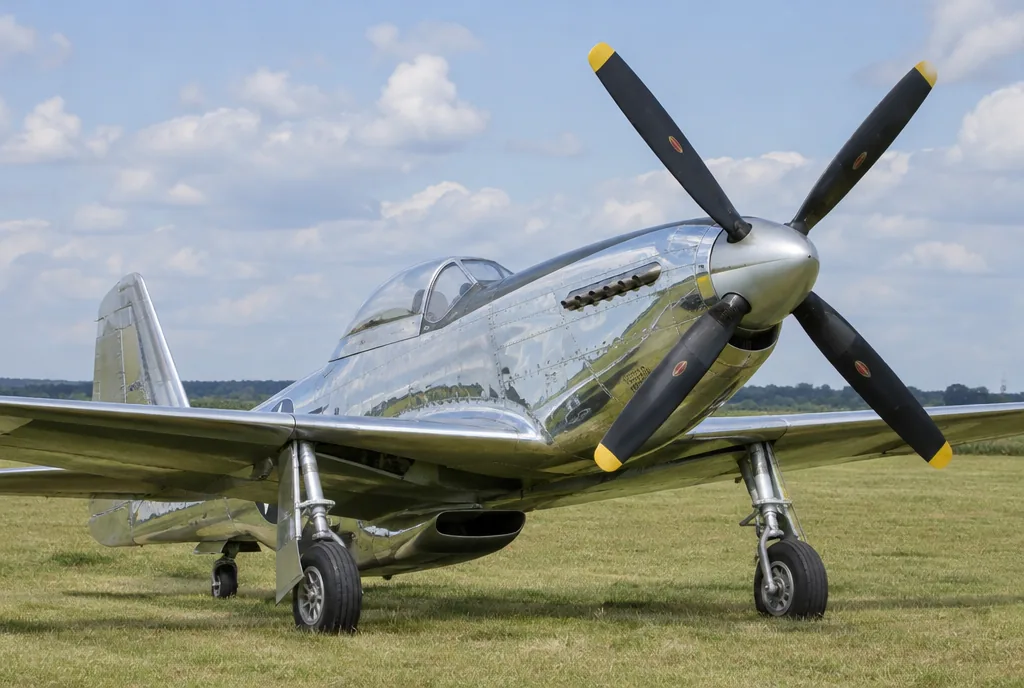
Was the P-51 better than the Spitfire? Not in every respect. At 25,000 feet, the P-51D reached 437 mph and had a range of 1,650 miles. A Spitfire Mk IX reached 408 mph and had a 434-mile range. That range difference made the Mustang the superior long-range escort: no Spitfire could escort bombers from England to Berlin, while the P-51 could.
| Measure | P-51D Mustang | Spitfire |
|---|---|---|
| Top speed | 437 mph at 25,000 ft | Mk IX: 408 mph; Mk XIV: 446 mph |
| Range | 1,650 miles | Mk IX: 434 miles |
| Climb rate | 3,475 ft/min | Mk XIV: 4,580 ft/min |
| Best fit | Long-range bomber escort | Turning and climbing below 20,000 ft |
In a short-range fight below 20,000 feet, the Spitfire was the stronger turning and climbing fighter. At 446 mph, the Mk XIV was about 9 mph faster than the P-51D, although the Air Fighting Development Unit called their top speeds “practically identical.” The Mustang’s laminar wing reduced drag at high speed; its mission was endurance. The Spitfire’s mission was rapid interception and maneuver. “Better” only has an answer after the mission is named.
Four Spitfire myths hide the more interesting story
- Myth: It won the Battle of Britain alone. Hurricanes were more numerous and accounted for about 656 of Fighter Command’s 1,107 credited kills; the two fighters had complementary jobs.
- Myth: Every Spitfire was essentially the same. The line ran from 1,030-hp Battle of Britain Merlins to Griffon-powered aircraft capable of 446 mph.
- Myth: Americans never flew it. The Eagle Squadrons and two USAAF fighter groups give the Spitfire a direct American service history.
- Myth: It was only a close-range fighter. PR Mk XI reconnaissance aircraft flew at 390 mph above 40,000 feet.
Frequently Asked Questions
Why is the Spitfire so famous?
It became the visual symbol of Britain’s air defense in 1940. Its adaptability also mattered: the aircraft stayed in front-line service from September 1939 through August 1945 and evolved through 24 main variants.
Who made the Spitfire plane?
At Supermarine, chief designer R.J. Mitchell designed the original aircraft. After his death in 1937, Joseph Smith and his team developed the later variants.
Did the U.S. use Spitfires?
From 1941, American volunteers flew RAF Spitfires in the Eagle Squadrons, and the USAAF’s 31st and 52nd Fighter Groups used Mk V and Mk IX Spitfires in North Africa and Italy.
Was the P-51 better than the Spitfire?
Because of its 1,650-mile range, the P-51 was the better long-range escort. Below 20,000 feet, the Spitfire was the better turning and climbing fighter; the answer depends on the mission.
How many flying Spitfires are left?
One detailed list of surviving aircraft counts 78 airworthy Spitfires and Seafires. Broader estimates put the number of airworthy aircraft at about 60 to 70, among roughly 240 preserved examples worldwide.