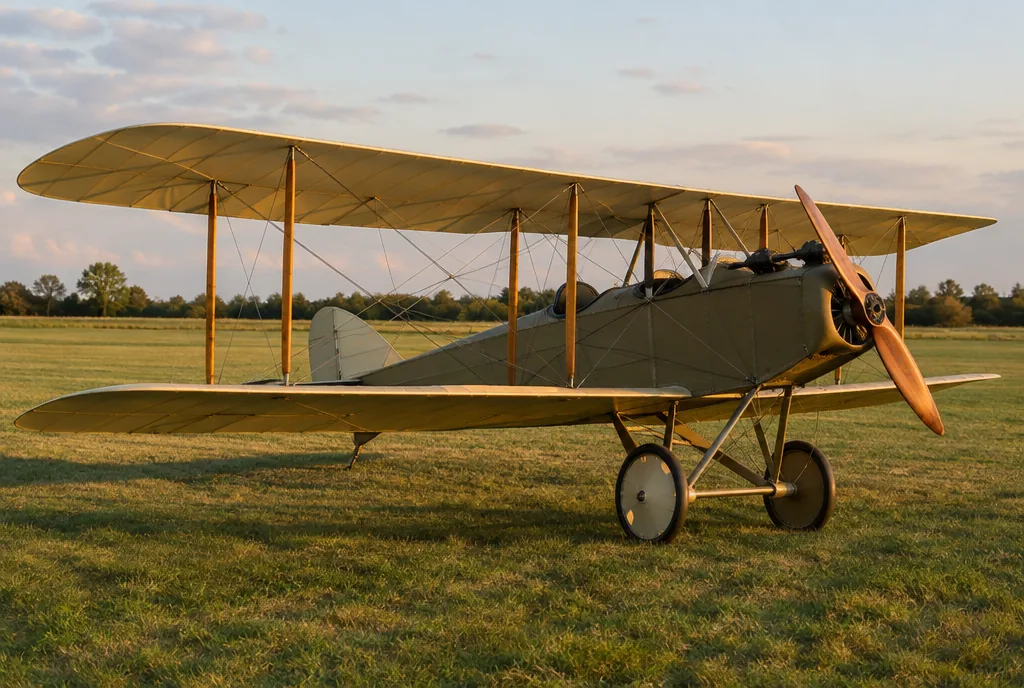
The Piper Cub was the small, yellow airplane that helped make flying feel attainable in the United States. Its best-known form, the Piper J-3 Cub, combined a fabric-covered steel-tube airframe, modest power, and unusually gentle low-speed behavior; it taught civilian pilots, served in war, and remains one of the most recognizable aircraft ever built. The story is richer than the familiar silhouette: it begins with a bankrupt company and a 20-horsepower engine, then reaches from college flight training to artillery observation over a battlefield.
How the Taylor Cub became the Piper J-3 Cub
The Cub’s lineage began with the Taylor Aircraft Company and the Taylor E-2 Cub, which first flew on September 12, 1930. Its 20-horsepower Brownback “Tiger Kitten” engine supplied more than power: the “kitten” name inspired the word “Cub.” That modest beginning suited an aircraft intended to make light flying practical rather than spectacular.
Money and persistence shaped the next chapter. In 1930, oilman William T. Piper bought a controlling interest in the bankrupt company for $761 while keeping C. Gilbert Taylor as president. Their partnership did not last. Piper took full control in 1935, and Taylor went on to establish Taylorcraft Aviation.
Then, in 1937, a fire destroyed the Bradford, Pennsylvania, factory. Piper Aircraft Corporation was formally founded that year, and production moved to Lock Haven, Pennsylvania. The first aircraft from the new Lock Haven plant was a J-3. A design born as a low-power E-2 had survived bankruptcy, a split between its principals, and the loss of its factory before becoming the airplane people remember.
Why the J-3’s simple structure mattered
The J-3 was a “tube and rag” airplane: a steel-tube framework covered in fabric. That approach ran from the E-2 through the later Super Cub, and it explains much of the Cub’s character. The structure favored low weight and directness over complexity; it also left an enduring maintenance obligation, because fabric covering eventually needs renewal.
Walter Jamouneau reworked the J-2 design for the J-3. The newer aircraft had a vertical fin fully integrated into the fuselage, a stronger steel-tube frame, and larger padded seats. Those are not dramatic changes at a distance, but they show the transition from an early Cub to the version that would become an American reference point.
Its color became part of the identity. The original finish was called Lock Haven Yellow, later Piper Cub Yellow, and it was paired with a black lightning stripe. The familiar paint scheme makes the airplane instantly legible in photographs, but the real reason for its importance lies in what the airframe enabled: a light airplane that could be used for training and ordinary flying at speeds that gave a new pilot time to think.
How the Cub trained a generation of pilots
President Franklin D. Roosevelt announced the Civilian Pilot Training Program on December 27, 1938. The program began in 1939 with 13 colleges and 330 students. By the summer of 1944, it had expanded to 1,132 institutions and 435,165 graduates. In that vast effort, the Piper J-3 Cub was not a footnote. Seventy-five percent of CPTP pilots trained on Piper Cubs.
The numbers carried forward into military aviation. After the war, 80 percent of U.S. military pilots had received their first flight instruction in a Piper Cub. First Lady Eleanor Roosevelt also appeared in a J-3 photograph for a CPTP campaign, a compact image of the program’s argument: learning to fly belonged in civilian life as well as military preparation.
Easy to fly is not the same as easy to fly well
The J-3’s stall speed of 33 knots made it notably forgiving for beginners. Its stall was gentle: with the stick held back, the nose dropped before the wings truly broke away. Yet the Cub demands a skill that the relaxed reputation can hide. It has strong adverse yaw, so a pilot must use the rudder consciously in turns. The airplane is often described as easy to fly but difficult to fly well, which is a useful distinction rather than a contradiction.
Several figures made its basic routine memorable. Best climb, approach, and glide all came at 60 mph. A solo pilot sat in the rear seat because the fuel tank was ahead of the front seat and the weight balance required that position. The original arrangement had no electrical system: no starter, radio, or transponder. Starting meant hand-propping. In one airframe, then, a student could encounter both a gentle stall and the discipline of coordinated rudder work.
How the L-4 Grasshopper took the Cub to war
The military version of the J-3 was the L-4 Grasshopper, initially designated O-59. Piper built 5,413 L-4s for U.S. forces. Their jobs were unglamorous but essential: artillery observation, liaison work, and medical transport. Slow speed and maneuverability, qualities that suited a training airplane, became practical advantages when crews had to observe ground activity or work close to the front.
With one pilot and no passenger, the L-4 had a range of 225 miles and an endurance of three hours. It cruised at 75 mph, reached 85 mph at maximum speed, and had a service ceiling of 12,000 feet. Those figures do not make it a fighter, and it was not one. The Grasshopper’s value was the ability to operate slowly and maneuverably; those same traits made it difficult for fighters to hit.
Its war began abruptly. Minutes before the Japanese attack on Pearl Harbor on December 7, 1941, sailor Marcus F. Poston was shot down while flying solo in a Piper J-3 over Oahu. It was the first American aircraft shot down in World War II. That morning, two more Cubs operated by K-T Flying Service, carrying three California National Guard soldiers, were also shot down; they were the first U.S. service members killed in the Pacific war. A small civilian-style airplane had become part of the opening record of America’s conflict.
What a Piper Cub plane can do on one tank
For the standard J-3C-65, the answer to the range question begins with the year of the airplane. Early models carried 9 gallons; 12 gallons became standard in 1939. At 75 percent power, fuel consumption is about 3.5 gallons per hour. A 12-gallon tank therefore suggests 3 to 3.4 hours in theory without reserve, while the commonly stated endurance is about two hours plus reserve.
Published range for the J-3C-65 is 191 nautical miles, or 220 miles (354 kilometers), at cruise. Cruise speed is 65 knots, maximum speed 76 knots, initial climb 450 feet per minute, and service ceiling 11,500 feet. The figures explain the Cub’s appeal without pretending it is fast: a 220-mile range is substantial for a light aircraft whose purpose was to make flying approachable.
| J-3C-65 figure | Published value | What it tells a pilot |
|---|---|---|
| Fuel capacity | 9 to 12 gallons | Capacity depends on year; 12 gallons was standard from 1939. |
| Fuel burn | About 3.5 gallons per hour at 75% power | Fuel planning matters more than the small tank suggests. |
| Range | 191 nautical miles / 220 miles | Range is a cruise figure, not a promise independent of conditions. |
| Cruise speed | 65 knots / 75 mph | The Cub trades speed for low-speed character and simplicity. |
Why the Piper Super Cub is a different airplane
The name “Cub” can conceal a major change in capability. The Piper PA-18 Super Cub arrived in 1949 and was produced from 1949 to 1983 and again from 1988 to 1994, for a total of 10,326 aircraft. Like the J-3, it used the tube-and-rag idea. In equipment and purpose, though, it moved well beyond the original trainer.
A Super Cub had three-position flaps, an electrical system, and a 150-horsepower Lycoming O-320, compared with the J-3’s 65 horsepower. With that power and those flaps, its stated takeoff run was 400 feet and landing run 300 feet. Those are genuine short takeoff and landing numbers, not merely a continuation of the J-3 story.
The distinction remains visible in use. The Super Cub is still used as a bush airplane, towplane, and banner tow aircraft. The J-3’s historical importance rests on training, simple flying, and its military transformation into the L-4. Both carry the Cub name; only the later airplane brings the flap-equipped, 150-horsepower short-field formula.
Why surviving Cubs are expensive
Piper built 19,888 J-3 Cubs between 1938 and 1947, including 19,073 in the United States, 150 in Canada, and 253 TG-8 gliders. More than 5,000 of the original J-3s remain registered with the FAA. That survival rate is remarkable, but it does not create an unlimited supply of sound, well-restored examples.
Demand meets an inventory more than seven decades old, much of it requiring restoration. Original aircraft may have no starter, heater, or electrical system, and their fabric covering needs renewal more often than the skin of a modern airplane. The difference is not just nostalgia: condition, restoration work, and originality directly affect what an owner is buying.
Market references illustrate the range. An AOPA report put used J-3s between $25,000 and $60,000 depending on condition. PlanePHD estimated an average market price of about $67,500. An original J-3 with the rarer 65-horsepower Franklin engine and a wooden propeller can command a premium over the more usual Continental A-65 version. A good Cub was about $2,500 in the 1970s; the rise since then has been more than twentyfold.
New Cub-inspired aircraft do not provide a cheap substitute. The American Legend AL3 was estimated from about $115,000, while the Carbon Cub UL began at about $255,000 and used Carbon Cub FX-3 aircraft were offered from about $325,000. New designs add conveniences such as an electrical system, starter, improved heating, and corrosion protection, but their prices underline why a well-kept original has become valuable.
The myths that obscure the real Cub
Myth: Every yellow Cub is a J-3
Fact: “Cub” spans a family. The J-3 ended production in 1947 and was replaced by the PA-11 Cub Special, which had a larger engine and a full cowling. The Super Cub was a later, much more powerful PA-18. Similar shapes do not make them the same airplane.
Myth: Piper still builds the original J-3
Fact: Piper no longer makes the J-3. Its modern lineup includes the Archer, M350, and M700 Fury. CubCrafters in Yakima, Washington, builds the CC11-100 Sport Cub S2, Carbon Cub, and XCub; American Legend Aircraft in Sulphur Springs, Texas, builds the Legend Cub AL3.
Myth: The Cub’s gentleness removes the need for technique
Fact: a 33-knot stall and a gentle recovery made the J-3 forgiving, not automatic. Adverse yaw requires deliberate rudder use, and hand-propping an original without a starter is a reminder that its simplicity asks more of the pilot, not less.
Frequently Asked Questions
Is the Piper Cub still being made?
Piper does not make the original J-3 Cub. The J-3 ended production in 1947, and the PA-11 Cub Special replaced it. Modern Cub-inspired aircraft are built by CubCrafters and American Legend Aircraft, not by Piper.
Is a Piper Cub easy to fly?
Its 33-knot stall and gentle stall behavior made the J-3 forgiving for beginners. It is not effortless: strong adverse yaw means pilots must coordinate turns with the rudder, which is why it can be easy to fly yet difficult to fly well.
How far can a Piper Cub fly on a tank of fuel?
A standard J-3C-65 has a published range of 191 nautical miles, or 220 miles, at cruise. Tank capacity varies from 9 to 12 gallons by year; at about 3.5 gallons per hour, the 12-gallon version has a theoretical 3 to 3.4 hours without reserve.
Why are Piper Cubs so expensive?
Strong demand meets a limited supply of aircraft built between 1938 and 1947, many needing careful restoration. Condition, fabric work, originality, and rare details such as a Franklin engine and wooden propeller all influence price.
What is the difference between a J-3 Cub and a Super Cub?
The 65-horsepower J-3 is the classic training-era Cub. The 150-horsepower PA-18 Super Cub has three-position flaps, an electrical system, and stated 400-foot takeoff and 300-foot landing performance, making it a substantially different short-field aircraft.