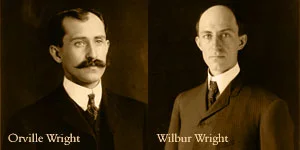
The first piloted, powered and controlled flight lasted 12 seconds. Behind it were four seasons of camping on a windswept sandbank in North Carolina, three gliders, a homemade wind tunnel and a long list of failures. Wilbur and Orville Wright did not stumble on flight; they worked toward it step by step between 1900 and 1903, and every step can be traced in their letters and diaries.
Why the Wrights chose Kitty Hawk
In 1900 the brothers asked the U.S. Weather Bureau where they could find steady, strong winds. Kitty Hawk, a fishing village on North Carolina’s Outer Banks, was on the list. The local weather station keeper, Joseph Dosher, and the postmaster, William Tate, wrote back describing open beaches and tall dunes. The location offered three things the Wrights needed:
- Wind: steady sea breezes of 15 to 25 miles per hour let a glider fly at low ground speed.
- Sand: soft landings for crashes, which were frequent.
- Isolation: few spectators and no reporters, important for inventors guarding their ideas.
From 1901 the brothers camped about four miles south of the village at Kill Devil Hills, a group of large sand dunes, and built a wooden shed for their machines.
Three gliders, three lessons
1900: the first glider
The 1900 glider was a biplane with a 17-foot wingspan and a weight of about 50 pounds. It had wing warping for roll control and a movable elevator in front for pitch. Because the winds were often too weak to carry a man, the brothers flew it mostly as an unmanned kite and measured the forces with a spring scale. Wilbur made only a few minutes of free glides that year, but the controls worked.
1901: a disappointment
The 1901 glider was larger, with a 22-foot span and a weight of nearly 100 pounds, and its wing curve followed the published data of Otto Lilienthal. It produced only about a third of the expected lift and was hard to control in turns. On the train home Wilbur told Orville that man would not fly in their lifetime; he later recalled saying fifty years. The brothers decided to trust only data they had gathered themselves.
1902: control solved
Over the winter they built a wind tunnel in Dayton and tested about 200 wing models. The 1902 glider had a 32-foot span, slender wings and, after a key change in the field, a single movable rudder linked to the wing warping. That gave the pilot coordinated control of roll, pitch and yaw. Between September and October 1902 the brothers made between 700 and 1,000 glides, some longer than 600 feet, and learned to fly in gusty wind. They filed a patent application on the control system the following spring.
Building the Flyer
The 1903 Flyer was a scaled-up 1902 glider with an engine. Its main features:
- wingspan of about 40 feet 4 inches and a weight of about 605 pounds
- a four-cylinder engine of about 12 horsepower, built by mechanic Charlie Taylor in the Wrights’ Dayton shop
- two wooden pusher propellers, 8.5 feet long, turning in opposite directions, driven by chains
- a pilot lying prone on the lower wing, steering with a hip cradle that worked the wing warping and rudder
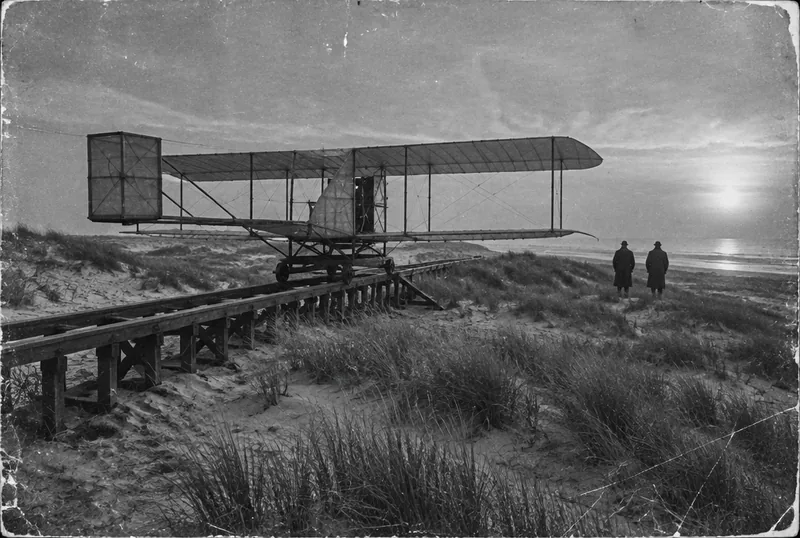
- skids instead of wheels, with a 60-foot wooden rail laid on the sand for takeoff
Autumn 1903: delays and repairs
The brothers reached Kill Devil Hills in late September 1903 and spent weeks repairing their camp, practicing on the 1902 glider and assembling the Flyer. Engine tests went badly: vibration loosened the propeller shafts, and in November one shaft cracked. Orville took the train back to Dayton, made new shafts of solid steel and returned on December 11. Time was short; winter weather was setting in, and the brothers wanted to be home for Christmas.
December 14: a false start
On December 14 the wind was light, so the brothers laid the rail down the slope of a dune. A coin toss gave Wilbur the first try. The Flyer left the rail, but Wilbur pulled up too steeply; it stalled after about three seconds and dropped into the sand, breaking some parts. The brothers did not count it as a flight because the machine had been helped by the downhill run and had not been under control.
December 17, 1903: four flights
Thursday, December 17 brought a cold north wind of about 27 miles per hour. The brothers hung out a signal flag to call the men of the Kill Devil Hills lifesaving station. Five witnesses came: John T. Daniels, Adam Etheridge and Will Dough from the station, W. C. Brinkley from Manteo, and a teenager named Johnny Moore.
This time the rail was laid on level ground. Orville took his turn at the controls. At 10:35 a.m. the Flyer ran along the rail and rose into the wind. It flew an up-and-down path for 12 seconds and landed 120 feet from where it had left the rail. Daniels, who had never used a camera before, squeezed the bulb on Orville’s tripod camera at the moment of takeoff and took one of the most famous photographs in history.
- Flight 1: Orville, 120 feet, 12 seconds
- Flight 2: Wilbur, about 175 feet
- Flight 3: Orville, about 200 feet, 15 seconds
- Flight 4: Wilbur, 852 feet, 59 seconds
While the men discussed the results, a strong gust caught the parked Flyer and rolled it over. Daniels was tangled in the frame and became the first person injured in an airplane accident, though only with bruises. The engine and ribs were badly damaged, and the Flyer never flew again.
The telegram home
In the afternoon the brothers walked to the weather station in Kitty Hawk and telegraphed their father, Bishop Milton Wright, in Dayton. The message reported success, four flights on Thursday morning, the longest lasting 57 seconds (a transmission error for 59), and added that they would be home for Christmas. Only a few newspapers ran the story, and most reports were badly garbled.
After Kitty Hawk
The Wrights moved their work to Huffman Prairie, a cow pasture near Dayton, in 1904. Without the strong sea wind they built a catapult tower to help takeoffs. On September 20, 1904, Wilbur flew the first complete circle by an airplane, and on November 9, 1904, he flew for just over five minutes, circling the field nearly four times. By 1905 their Flyer III could stay up for more than half an hour. The longer story is told in our history of the first airplane, and the anniversary celebrations of 2003 are covered in our article on the First Flight Centennial.
Frequently Asked Questions
Who flew the first piloted airplane flight?
Orville Wright, on December 17, 1903, at 10:35 a.m. at Kill Devil Hills near Kitty Hawk, North Carolina.
Why did Orville fly first instead of Wilbur?
Wilbur won a coin toss and made the first attempt on December 14, but it ended in a stall. On December 17 it was Orville’s turn.
Who took the photograph of the first flight?
John T. Daniels of the Kill Devil Hills lifesaving station, using Orville’s camera set up on a tripod.
How fast did the first airplane fly?
Its airspeed was about 30 miles per hour, but against the strong headwind its speed over the ground was only around 7 miles per hour.