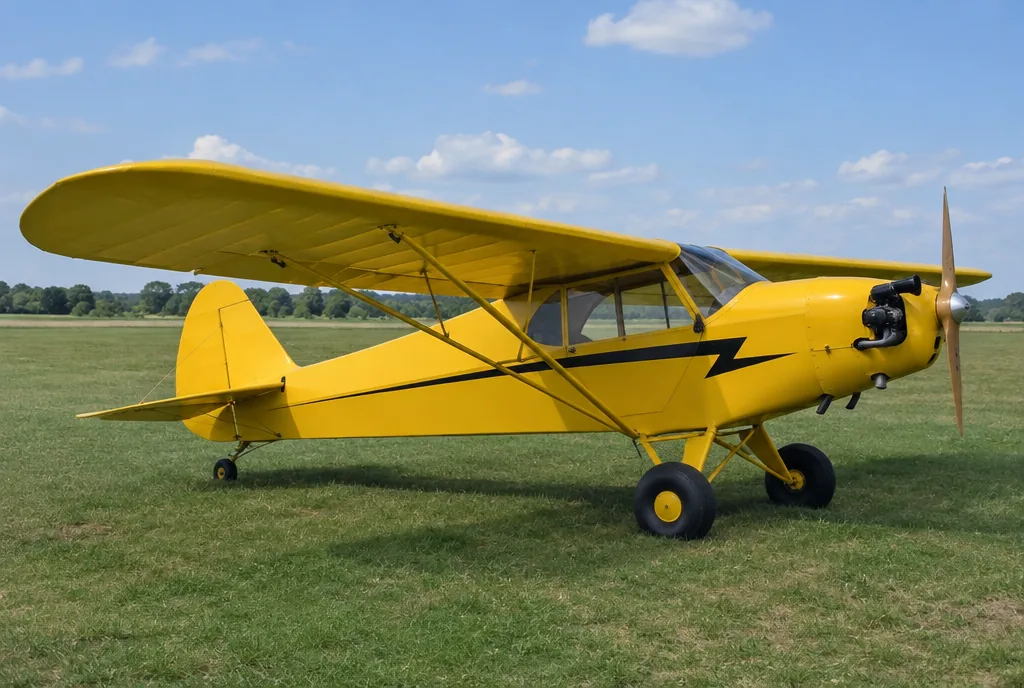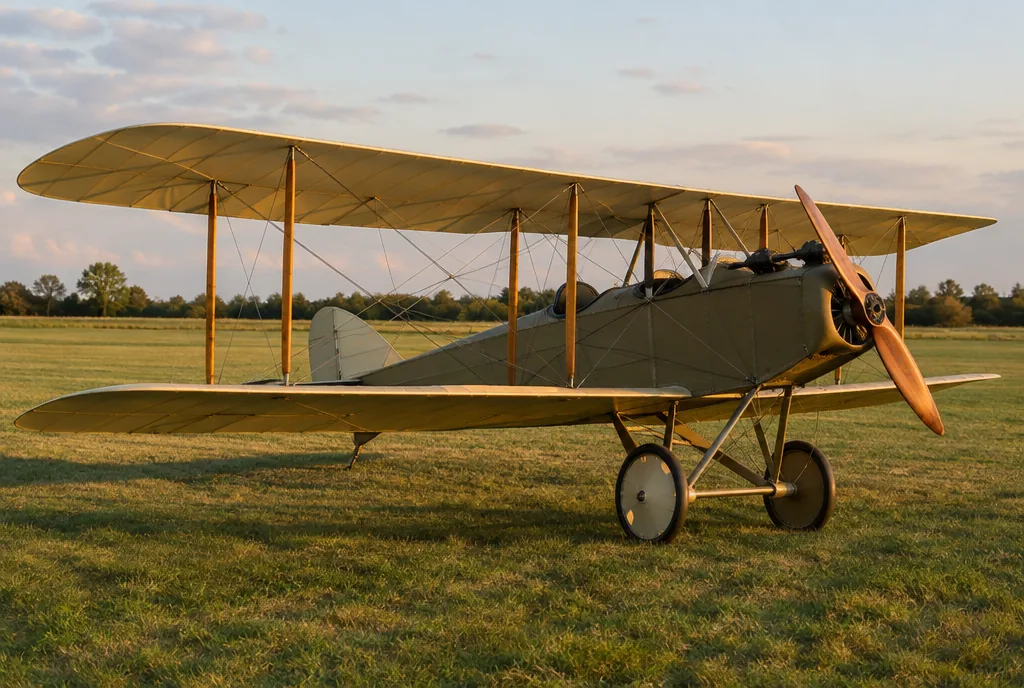
Barnstormers were pilots and performers who carried aviation to rural America after World War I, landing on fields, selling short rides, and turning a biplane into a public show. In the barnstorming era, roughly 1918 to 1927 or 1929, a person who had never seen an airplane close up could pay for a ride, watch an aerial stunt, and see flight become something more immediate than a wartime headline.
Why Barnstormers Took Flight Across Rural America
Barnstorming was a traveling aviation business. Working alone or with a small group, a pilot moved from place to place, landed in a field, and made money from joyrides and admission to aerobatic demonstrations. Many of these operators worked without radio, maps, or air-traffic controllers. Their landing place was often a field rather than an airport, which brought the airplane to communities far from the places where aviation was usually seen.
The word did not begin in aviation. In the nineteenth century, theater companies that toured rural areas and performed in barns were called barnstormers. Around 1928, the name was applied to traveling flying circuses. It suited an enterprise built around arrival, performance, and departure: a show could come to town with a small number of people and machines, draw a crowd, and then move on.
The basic transaction was direct. For a joyride lasting five to 15 minutes, a passenger generally paid $1 to $5; an audience could also buy admission for stunt flying. At those prices, the airplane became an experience rather than a distant invention. Through barnstorming, millions of Americans in rural areas encountered an aircraft for the first time, and many had never previously seen one from close range.
That reach is central to the story. Barnstorming was not simply a collection of reckless feats. It was an early form of public aviation, sustained by pilots who had to find passengers, keep an aircraft operating, and offer a spectacle vivid enough to make people gather at a field.
The Curtiss Jenny Made a Flying Business Possible
Most closely associated with the barnstormer was the Curtiss JN-4, better known as the Jenny. The two-seat biplane was powered by a 90-horsepower OX-5 engine and had a top speed of about 70 mph. Maneuverable and comparatively forgiving for beginners, the Jenny had qualities that mattered to a pilot selling rides or learning to perform. At the same time, its power was modest and its rate of climb poor even by the standards of its own day.
For commercial operators, availability made that mix of strengths and weaknesses important. In all, 6,813 JN-4s were built, more than 6,000 of them during World War I, making it the most-produced American aircraft of the war. In 1918, the U.S. Army paid $5,465 for a new Jenny. After the war, surplus examples sold for $200 to $500. Historical reports also place some crated aircraft as low as $50, but that lower figure is not from an official price list.
| Jenny detail | What it meant to a barnstormer |
|---|---|
| Two seats | One pilot could carry a paying passenger on a joyride. |
| 90-hp OX-5 engine | It delivered about 70 mph, but limited climbing performance. |
| 43 ft 7.75 in wingspan | The large biplane wing was part of the Jenny’s familiar silhouette. |
| 27 ft 4 in length and 1,390 lb empty weight | These dimensions belonged to the common surplus trainer that became a civilian workhorse. |
| Payload of about 660 lb (300 kg) | Pilot and as many as two passengers had to fit within a limited load; overloading was a recurring error. |
The Jenny was not the only choice. Alongside it, barnstormers used the Standard J-1, the Curtiss Canuck, the de Havilland DH.4, and civilian types including the Curtiss Oriole. Still, because so many were available after the war and because its second seat could earn its keep, the Jenny became the emblem of the trade.
Charles Lindbergh’s purchase shows how such a machine entered the business. In May 1923, he bought a Jenny in Americus, Georgia, for $500. A new OX-5 engine, fresh paint, and an extra fuel tank came with it. From there, he began barnstorming in Georgia, Alabama, and Mississippi, selling rides for $5 apiece.
Wing Walking Made the Airplane a Stage
Wing walking supplied the era’s most recognizable image and its greatest danger. With the engine running and the aircraft in flight, a performer left the cockpit, climbed onto a lower or upper wing, and performed there. Among the acts were a headstand on the upper wing, hanging by teeth or ankles, moving between two airborne aircraft, or transferring from a moving car to an airplane.
Ormer Locklear’s first documented wing walk came from a practical problem rather than a show. In 1918, while serving as a flight instructor in the U.S. Army Air Service, he left his cockpit during a training flight to fasten a loose radiator cap. On June 1, 1919, in Atlantic City, he made the first publicly advertised mid-air transfer from one aircraft to another.
That same skill made Locklear a prominent performer, but it did not make the work safe. He died on August 2, 1920, during nighttime filming of The Skywayman. Searchlights blinded the pilot, and the Jenny crashed into an oil tank. Locklear was 28. During demonstrations in the early 1920s, at least eight wing walkers died, although the surviving record is incomplete.
Lillian Boyer made the scale of the work unmistakable. Between 1921 and 1929, she gave 352 shows in 41 U.S. states and Canada. Her record included 143 automobile-to-airplane transfers and 37 parachute jumps, 13 of them over Lake Erie. In 1921, she had begun as a waitress invited on a ride by two customers; on her second flight, she climbed onto the wing. As the first woman to complete a mid-air transfer between two airplanes, Ethel Dare also made history.
Later rules reflected the hazard. In 1936, the United States prohibited wing walking below 1,500 feet. Low-level wing walking is now practically limited to strict exceptions.
Flying Circuses Turned Individual Acts Into Touring Shows
A flying circus was the organized version of the barnstorming idea. Rather than a single pilot and airplane, it brought together multiple pilots, aircraft, and a set program that might combine aerobatics, wing walking, and parachute jumps. The format made it possible to present a larger event while retaining the touring character of a field-side show.
The Gates Flying Circus was the most spectacular example. Founded in 1921 by Ivan Gates and Clyde Pangborn, it performed over the years in as many as 44 states. According to Time magazine, the organization sold more than 1.2 million rides. That figure shows the scale of the business: the flying circus was not only a stunt program but also a way to put a remarkable number of people into an airplane.
Other groups revealed how varied the format could be. The Los Angeles-based 13 Black Cats, active from 1924 to 1929, consisted of 13 pilots. The troupe charged $100 for inverted-flight instruction and as much as $1,500 to show an airplane deliberately blown up in midair. The Five Blackbirds were among the first African American flying-circus groups, performing in the 1920s as a counterpart to the white troupes. Mabel Cody, Buffalo Bill Cody’s niece, operated her own flying circus through the Midwest and West and included car-to-airplane transfers in her act.
Several other operations widened the picture. Ruth Law toured with her own flying circus after setting a nonstop distance record of 590 miles. The Inman Brothers Flying Circus of Wichita, Kansas, became known for precision aerobatic formations. Marie Meyer led one of the relatively few truck-and-troupe shows run by a woman.
The Famous Barnstormers Were More Than One Type of Pilot
Charles Lindbergh is among the best-known names connected with barnstorming, but the era included record setters, performers, entrepreneurs, and flyers who broke barriers. Their later achievements do not prove that barnstorming caused each success. Instead, they show how a network of training, exhibition, and touring flight encompassed people whose careers later reached far beyond a single field.
- Bessie Coleman became the first African American and first Indigenous woman, of Choctaw heritage, to hold an international pilot’s license in 1921. She toured as a barnstormer until her death in a crash on April 30, 1926.
- Katherine Stinson, known as “The Flying Schoolgirl,” became the first woman to fly a loop on July 18, 1915, over Cicero Field in Chicago. She was also the first woman pilot to fly at night and to demonstrate skywriting.
- Roscoe Turner flew with a tame lion named Gilmore as a cockpit mascot. He later won the Thompson Trophy three times, in 1934, 1938, and 1939.
- Clyde “Upside-Down” Pangborn completed the first nonstop flight across the Pacific in October 1931, flying from Misawa, Japan, to Wenatchee, Washington, in 41 hours and 13 minutes.
- Wiley Post lost an eye in an accident but continued in barnstorming shows. In 1931, he set a round-the-world record of eight days, 15 hours, and 51 minutes and developed the first pressure suit.
- Lincoln Beachey was the first U.S. pilot to fly a loop in 1914 and is credited with inventing inverted flight. He died in a crash before an audience in San Francisco on March 14, 1915.
The Air Commerce Act Changed What It Took to Fly for Hire
The freedom that made barnstorming possible also made its business fragile. On May 20, 1926, President Calvin Coolidge signed the Air Commerce Act, the first comprehensive aviation-regulation law in the United States. Under the law, the Secretary of Commerce took responsibility for licensing pilots, certificating aircraft, and operating air routes.
On December 31, 1926, the first Air Commerce Regulations took effect. They required licenses for all commercial pilots, who were classified as transport or industrial pilots. Certification began even earlier: on December 7, 1926, the first airworthiness certificate went to a Stinson Detroiter; on March 29, 1927, the first type certificate went to a Buhl Airster. On April 6, 1927, the first pilot license was issued to William P. MacCracken Jr., the first Assistant Secretary of Commerce for Air, after Orville Wright declined the offer.
For operators dependent on older surplus machines, the changes were expensive. Pilots had to pass examinations, and aircraft had to be maintained and certificated. In 1929, Lillian Boyer left the business, citing federal rules on low flying and unsafe airplanes as reasons many barnstormers had been forced into retirement. The Act was the direct forerunner of the Civil Aeronautics Administration (1938) and, later, the Federal Aviation Administration (1958).
The end of the classic era did not mean that its influence disappeared. In 1929, the United States had an estimated 8,000 civilian pilots; by 1940, it had more than 15,000. A substantial share had gained experience as barnstormers.
Barnstorming Myths Miss the Business and the Risk
Myth: Every barnstormer was a lone daredevil
Some pilots did travel alone or in small groups, but flying circuses were organized troupes with several aircraft, performers, and a planned program. Selling joyrides and admission required business as well as nerve.
Myth: The Jenny was a powerful stunt machine
The Jenny was maneuverable and relatively forgiving, not powerful. Its 90-horsepower engine and poor climb were real limitations, especially when the pilot, passengers, and a payload of about 660 lb (300 kg) pushed the aircraft toward its limits.
Myth: A $50 Jenny was a standard official price
Some historical reports describe crated surplus Jennys selling for $50. The figure is often repeated, but it does not come from an official price list. The documented postwar surplus range was $200 to $500.
Myth: Wing walking was harmless entertainment
Its visual daring was real, and so was the danger. The deaths of at least eight wing walkers in the early 1920s and the later low-altitude restrictions show why the stunt carried consequences beyond applause.
Frequently Asked Questions
What are barnstormers?
Barnstormers were pilots and performers who toured rural America, landed on fields, sold passenger rides, and staged aerial demonstrations. The classic era ran from the end of World War I to the late 1920s.
Why were they called barnstormers?
The name came from nineteenth-century theater companies that traveled through rural areas and performed in barns. Around 1928, the term was transferred to traveling flying circuses.
What plane did barnstormers fly?
The Curtiss JN-4 Jenny was by far the most common aircraft. Other barnstorming types included the Standard J-1, Curtiss Canuck, de Havilland DH.4, and Curtiss Oriole.
Who were the most famous barnstormers?
Charles Lindbergh, Bessie Coleman, Katherine Stinson, Roscoe Turner, Clyde Pangborn, Wiley Post, and Lincoln Beachey are among the most prominent names. Lillian Boyer and Ormer Locklear are especially associated with wing walking.
How did the barnstorming era end?
The Air Commerce Act of 1926 brought pilot licensing and aircraft certification, making older surplus operations more costly. By 1929, increased regulation and aging machines had brought the classic era close to its end.