By combining the range to stay with Allied bombers deep into Germany with the speed and high-altitude performance to fight there, the P-51 Mustang became famous. That combination was not present in the first airplane. Instead, a remarkable 1940 design effort, a change from the Allison engine to the Rolls-Royce Merlin, and practical decisions about fuel, visibility, and control created it. By March 1944, Mustangs could escort B-17s and B-24s to Berlin; by war’s end, the airplane’s record and the people who flew it had made its name inseparable from World War II air warfare.
North American built the Mustang in 102 days
At Inglewood, California, North American Aviation, usually called NAA, made the P-51 Mustang. The company’s chief, James “Dutch” Kindelberger, and chief designer Edgar Schmued led the work. The British Purchasing Commission placed the 1940 order with North American after Curtiss, which had originally received the request, faced capacity problems. Rather than simply build an existing Curtiss design, North American designed a new fighter.
In its demanding brief, the commission required an inline engine, a prototype in 120 days, and a unit price no higher than $40,000. Just 102 days after the contract was signed, the NA-73X prototype was ready and made its first flight at Inglewood on October 26, 1940. Part of the Mustang story lies in the speed of that process, but not all of it. Even a quickly completed aircraft still had to solve the problem of the war being fought above it.
From January 1942, the Royal Air Force used the early aircraft as the Mustang Mk. I. Initially, it conducted tactical reconnaissance and fighter-bomber operations rather than the long-range, high-altitude escort work for which it would later be remembered. From 1940 through the end of the war, more than 20 Mustang variants were produced, including Allison-powered Mustang I, P-51A, and A-36A Apache aircraft, and Merlin-powered P-51B, P-51C, P-51D, P-51H, and P-51K models.
Eventually, production reached 15,586 P-51s of all versions, including roughly 8,000 P-51Ds. Among U.S. fighters, only the P-47 Thunderbolt was built in greater numbers, making the Mustang one of the most numerous American fighters of World War II. In 1945, a P-51D cost about $50,985 to build. More important than the quantity, the basic airframe could accept a transformation that its original engine could not provide.
The Rolls-Royce Merlin gave the P-51 its missing altitude
In its earliest form, the NA-73X used the Allison V-1710, rated at 1,150 horsepower. At lower altitudes, the aircraft showed promise. Above 15,000 feet, however, the Allison lost power sharply. As a result, the early Mustang was unsuitable as a high-altitude fighter, exactly where bomber formations and enemy interceptors would meet over Europe.
From Rolls-Royce came the answer: the Merlin. In October 1942, Rolls-Royce at Derby installed a Merlin 61 in Mustang Mk. I AM121. Known as Mustang X, the converted aircraft immediately exceeded 440 mph. Beyond that headline speed figure, its importance lay in altitude performance. With a two-stage, two-speed supercharger, the Merlin supplied compressed air at altitude, allowing the engine to retain useful power where the Allison-powered Mustang had faltered. Above 25,000 feet, the change made the Mustang competitive.
American mass production made the new combination practical. Packard Motor Car Company in Detroit had been building Merlin engines under license from September 1940; in August 1941, the first Packard Merlin, the V-1650-1, ran. Under the $130 million agreement, Packard ultimately produced 55,523 Merlins, thousands of them for P-51B, P-51C, P-51D, and P-51H fighters as well as British aircraft including the Spitfire and Lancaster.
| Engine and aircraft | Power or performance | Why it mattered |
|---|---|---|
| Allison V-1710 in the NA-73X | 1,150 hp; power fell sharply above 15,000 ft | Limited the early Mustang as a high-altitude fighter |
| Merlin 61 in Mustang X | More than 440 mph in October 1942 testing | Showed what the airframe could do with a two-stage, two-speed supercharger |
| Packard V-1650-7 in the P-51D | 1,490 hp at military power; 1,720 hp at war emergency power | Provided the high-altitude power needed for escort work |
Rather than being a literal one-for-one copy of the British original, the Packard V-1650 included its own changes: metric-to-inch conversion, different carburetors, and bushings rather than roller bearings in some locations. For the operational Mustang, the important result was an American-built Merlin installation joining a low-drag airframe to an engine system able to work in thin air.
Fuel tanks turned speed into a Berlin escort mission
As the first single-seat fighter capable of accompanying heavy B-17 and B-24 bombers from East Anglia to Berlin and back, the P-51 achieved its defining role through endurance as much as speed. A fast fighter that had to turn for home before the bombers reached their target could not protect them during the most dangerous part of the mission.
Beginning with the P-51B-5-NA, an 85-U.S.-gallon self-sealing fuel tank sat behind the pilot’s seat. On the P-51D, crews could combine that fuselage tank with two 108-U.S.-gallon paper-laminate drop tanks. With that arrangement, maximum range was 2,055 miles. The disposable tanks were a British idea: cheap enough to make in quantity and could be dropped when empty rather than carried through combat.
In March 1944, U.S. Army Air Forces Mustangs first flew escort all the way to Berlin. From then on, German fighters could no longer assume that attacking a bomber stream far from England meant that the escort would have disappeared. During the following months, the German fighter force suffered losses so severe that it was effectively worn down as a daylight fighting force.
Range did not make the Mustang passive. At 25,000 feet, the P-51D had a top speed of 437 mph and a service ceiling of 41,900 feet. Its six .50-caliber Browning AN/M2 machine guns carried 1,880 rounds in total. The laminar-flow wing, a North American aerodynamic feature, created substantially less drag at high speed than conventional wing sections. That was an important advantage over the Spitfire and the Bf 109, but it became strategically decisive only when tanks and engine allowed the aircraft to carry that speed far from base.
The P-51D let pilots see and control the fight
More than a styling change, the P-51D’s famous bubble canopy made the most recognizable Mustang easier to use in combat. Earlier P-51B and P-51C aircraft had a framed rear fuselage and canopy often described as a “birdcage.” The P-51D’s cut-down rear fuselage and bubble canopy gave the pilot unrestricted all-around vision. In a fighter engagement, seeing an aircraft approaching from behind or below could determine whether a pilot had time to react.
With that improvement came an engineering problem. Cutting down the rear fuselage reduced the effective vertical tail area and introduced a dangerous yaw tendency. North American fixed it with a dorsal fin fillet, an added extension at the base of the vertical tail. Easy to overlook in a photograph, the detail made the new canopy arrangement usable rather than merely attractive.
- Bubble canopy: replaced the earlier enclosed rearward view with unrestricted visibility around the aircraft.
- Dorsal fin fillet: increased directional stability after the cut-down fuselage reduced the side fin area.
- Laminar-flow wing: reduced drag at high speed, supporting the Mustang’s fast cruise and fighting performance.
- Six Browning guns: gave the P-51D a total of 1,880 rounds of .50-caliber ammunition.
Not every famous Mustang number belongs to the D model. Merlin-powered P-51B and P-51C aircraft could reach 439 mph, slightly faster than the P-51D’s 437 mph because the bubble canopy added some drag. The P-51H went farther still: with a Packard V-1650-9 using water-alcohol injection, it could produce up to 2,270 horsepower at 10,200 feet in war emergency power and reach 487 mph. It first flew on February 3, 1945, too late for a wartime role, and only 555 were built.
The Tuskegee Airmen made the Red Tail Mustang unforgettable
Without the 332nd Fighter Group, the P-51’s history is incomplete. Its four squadrons were the 99th, 100th, 301st, and 302nd. In July 1944, the group began changing from the P-47 Thunderbolt to the Mustang. Bright red tail surfaces and propeller spinners, with yellow stripes on the wings, gave their aircraft the name “Red Tails.”
From Ramitelli, Italy, the 332nd flew with the Fifteenth Air Force deep into Austria, Czechoslovakia, Hungary, Poland, and Germany. Before receiving the Mustang, the group had flown P-40 Warhawks, P-39 Airacobras, and P-47 Thunderbolts. The 99th Fighter Squadron had already earned two Presidential Unit Citations, for tactical air support in Italy in June-July 1943 and in May 1944.
On March 24, 1945, Colonel Benjamin O. Davis led 43 P-51 Mustangs on a 1,600-mile escort mission to Berlin and back. Three Tuskegee pilots shot down German Me 262 jets that day, three jet victories on a single mission. The action earned the 332nd Fighter Group a Presidential Unit Citation, the highest award given to a U.S. unit.
The group’s escort record shows what the Red Tails’ reputation rests on. Across 179 bomber-escort missions, bombers were lost to enemy action on only seven missions, for a total of 27 bombers. Other P-51 groups in the Fifteenth Air Force averaged 46 bomber losses. Rather than reduce the group’s story to paint color or a slogan, those figures show what sustained escort work looked like across a large number of missions.
P-51 Mustang versus Spitfire: better for which mission?
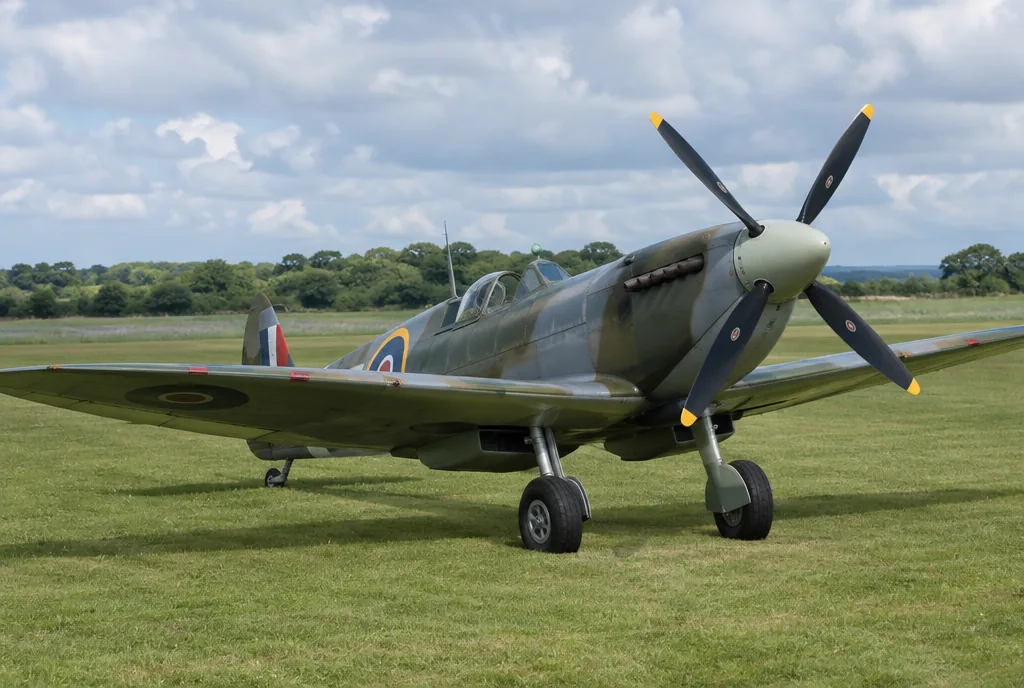
Was the P-51 better than the Spitfire? No single winner is useful. Although both used versions of the Merlin engine, the P-51D and Spitfire Mk IX reflected different operational strengths. For a long-range escort over occupied Europe, the Mustang’s range was its defining advantage. In a climb, the Spitfire Mk IX held the advantage.
| Measure | P-51D Mustang | Spitfire Mk IX |
|---|---|---|
| Top speed | 437 mph | 408 mph |
| Range with external tanks | 1,650 miles | 434 miles |
| Climb rate | 3,475 ft/min | 3,950 ft/min |
| Service ceiling | 41,900 ft | 43,000 ft |
| Engine power | 1,490 hp | 1,565 hp |
The Mustang was about 7 percent faster at top speed and had nearly four times the range with external tanks. The Spitfire climbed about 14 percent faster and had a slightly higher ceiling. Its Merlin 66 produced 1,565 horsepower, compared with the P-51D’s 1,490-horsepower Packard V-1650-7. Yet the Mustang’s aerodynamic efficiency offset some of that engine-power difference. The comparison uses a more conservative Mustang range figure than the 2,055-mile maximum quoted above.
In other words, “better” depends on the job. The Spitfire offered a faster climb; the Mustang could reach a distant bomber formation, remain with it, and return. By comparing the two only by top speed, readers erase the decision that mattered to escort crews: how far a fighter could carry its performance. Neither was a rarity: 15,586 P-51s of all variants were built, while about 20,351 Spitfires of all variants were produced.
The Mustang’s legend is strongest when the myths are removed
In World War II records, the P-51 received credit for 4,950 air victories, 4,131 ground kills, and 230 V-1 flying bombs destroyed. Those numbers help explain why the type became iconic, but several common shortcuts distort the aircraft’s development and roles.
Myth: the P-51 was always a Merlin fighter
It was not. The original aircraft used the Allison V-1710, and the early RAF Mustang Mk. I served in reconnaissance and fighter-bomber duties. The Merlin conversion changed the aircraft’s high-altitude capability, but it came after the airframe had already flown and entered service.
Myth: every Mustang was a P-51D
The D was the best-known version, with roughly 8,000 built, but it was one of more than 20 variants. The earlier B and C could be slightly faster, while the later H was the fastest production Mustang. The RAF used Mustang Mk III for Merlin-powered P-51B and P-51C aircraft and Mustang Mk IV for P-51D and P-51K aircraft.
Myth: the P-51 was designed as a dive bomber
The P-51 was never officially intended as a dive bomber, although it was used in that role. The related Allison-powered A-36A Apache was specifically developed as a dive bomber and carried dive brakes. After World War II, Mustangs continued in service beyond the role that made them famous: the U.S. redesignated them F-51s in the Korean War, where they initially served as primary fighters before jets such as the F-86 Sabre took over and the Mustang became more specialized as a fighter-bomber.
A flying P-51 is a multimillion-dollar commitment
Flyable P-51Ds have recently been offered for $2.0 million to $3.5 million, depending on condition, restoration level, and history. That price reflects an aircraft that is both rare and demanding to operate. Of roughly 300 surviving P-51s, about half—approximately 150—are still airworthy.
Purchase price is only the opening cost. A P-51D burns about 65 gallons of fuel per hour in cruise, or about one liter every 1.5 seconds. At a fuel price of about $3.50 per gallon, fuel alone works out to about $227.50 per flight hour. Oil consumption, hangar space, insurance, and the work needed to keep a complex vintage engine operating add to that baseline.
The Packard V-1650 needs regular attention to cylinder heads and valves beginning at about 300 operating hours. It also uses one to two quarts of oil every five to ten hours. A TF-51D conversion, which adds a rear seat and dual controls, costs about $250,000 extra. For comparison, the U.S. military sold surplus Mustangs in the late 1950s for $800 to $1,500 each. The contrast captures the shift from postwar surplus to preserved historic aircraft.
Frequently Asked Questions
Why is the P-51 Mustang so famous?
It combined high-altitude Merlin power, low-drag aerodynamics, and the range to escort B-17 and B-24 bombers from East Anglia to Berlin and back. Its 4,950 credited air victories, 15,586-aircraft production run, and service with units such as the 332nd Fighter Group secured its reputation.
Was the P-51 better than the Spitfire?
For long-range escort, the P-51D had the stronger case: 1,650 miles of range with tanks against 434 miles for the Spitfire Mk IX, plus a 437 mph top speed against 408 mph. The Spitfire Mk IX climbed faster and had a slightly higher service ceiling, so the answer depends on the mission.
How much is a P-51 Mustang worth today?
Flyable P-51Ds have recently been offered for $2.0 million to $3.5 million, with price depending on condition, restoration level, and history. About 150 of the roughly 300 surviving P-51s remain airworthy.
How much does it cost to fly a P-51 Mustang?
A P-51D uses about 65 gallons of fuel per hour in cruise. At a fuel price of about $3.50 per gallon, that is about $227.50 per hour for fuel alone, before oil, engine work, hangar space, and insurance.
Who made the P-51 Mustang?
North American Aviation developed the aircraft in Inglewood, California, under company chief James “Dutch” Kindelberger and chief designer Edgar Schmued. Later high-altitude versions used Rolls-Royce Merlin engines built under license by Packard in Detroit.