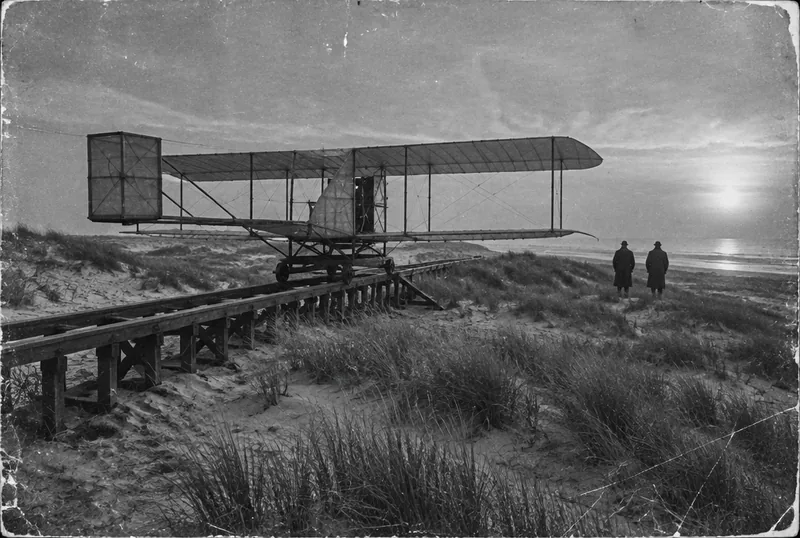
On 17 December 1903 Orville Wright flew 120 feet in twelve seconds over the sand at Kill Devil Hills, North Carolina. One hundred years later, to the hour, some 35,000 people stood in cold rain at the Wright Brothers National Memorial to watch a replica try to do it again. The centennial was the largest celebration in the memorial’s history and the climax of a year of events across the state.
The First Flight Centennial Commission
North Carolina created a commission in the 1990s to plan the anniversary, alongside the federal Centennial of Flight Commission and Ohio’s own programme in Dayton, the Wrights’ home town. The North Carolina programme ran through 2003 with exhibitions at the North Carolina Museum of History in Raleigh, travelling displays, school competitions and a summer air show, and it funded the First Flight Centennial Pavilion.
The pavilion
The pavilion, a large temporary exhibition structure erected at the memorial for the anniversary season, housed exhibits on the Wrights’ four years of experiments at Kitty Hawk, on the Outer Banks lifesaving station crew who helped them, and on a century of aviation since, with artifacts lent by the Smithsonian and by aerospace companies. It was designed to be taken down after the celebration; the permanent visitor center, built in 1960, remained and was renovated in 2018.
17 December 2003
The programme featured President George W. Bush, who spoke in the morning, flyovers by military and historic aircraft, and appearances by astronauts including John Glenn and Neil Armstrong. The centrepiece was the 1903 Flyer replica built by the Wright Experience in Virginia, the most exact reproduction ever attempted, with a pilot trained on earlier Wright glider replicas. At 10:35 a.m., the moment of the original flight, the engine ran up in rain and low wind, the Flyer rolled down its launching rail and settled into a puddle without lifting off. A second attempt in the afternoon was abandoned. The failure disappointed the crowd but taught the historians something: the Wrights’ 27-mile-per-hour headwind on the original day had been essential, and their machine had been marginal even for them.
What remains
The Wright Experience replica is displayed at the Outer Banks Visitors Bureau’s Monument to a Century of Flight in Kill Devil Hills; the memorial’s visitor center holds a reproduction of the Flyer and the reconstructed camp buildings stand where the brothers lived. Each 17 December a smaller ceremony marks the anniversary.
This site is an independent aviation history publication and is not the former Centennial Commission.