On December 17, 1903, at 10:35 in the morning, Orville Wright flew 120 feet in 12 seconds over the sand at Kill Devil Hills, North Carolina. One hundred years later, to the minute, about 35,000 people stood in cold rain at the Wright Brothers National Memorial to watch an exact replica try to repeat the feat. The First Flight Centennial was the largest gathering in the memorial’s history and the climax of a full year of events in North Carolina, Ohio and across the country.
What happened on December 17, 1903
The Wrights had spent four seasons on the Outer Banks, chosen for its steady winds, soft sand and isolation. On the morning of the first flight the wind blew at about 27 miles per hour, strong enough that the Flyer needed only a short run along its 60-foot wooden launching rail.
- Flight 1: Orville, 120 feet in 12 seconds
- Flight 2: Wilbur, about 175 feet
- Flight 3: Orville, about 200 feet
- Flight 4: Wilbur, 852 feet in 59 seconds
Five local men, most of them from the Kill Devil Hills lifesaving station, witnessed the flights. John T. Daniels took the famous photograph of the first takeoff with Orville’s camera. Shortly after the fourth flight a gust flipped the parked Flyer and damaged it; it never flew again.
Planning the centennial
Preparations began years in advance on three levels:
- Federal: Congress created the U.S. Centennial of Flight Commission in 1998 to coordinate national events, education programs and publications.
- North Carolina: the First Flight Centennial Commission organized the celebration at the memorial and events across the state, including exhibitions at the North Carolina Museum of History in Raleigh, school programs and a commemorative license plate with the slogan “First in Flight.”
- Ohio: Dayton, the Wrights’ home town, staged “Inventing Flight,” a large air show and festival in July 2003 that highlighted the brothers’ workshop, their later experiments at Huffman Prairie and the city’s aviation heritage.
The Countdown to Kitty Hawk and the replica Flyer
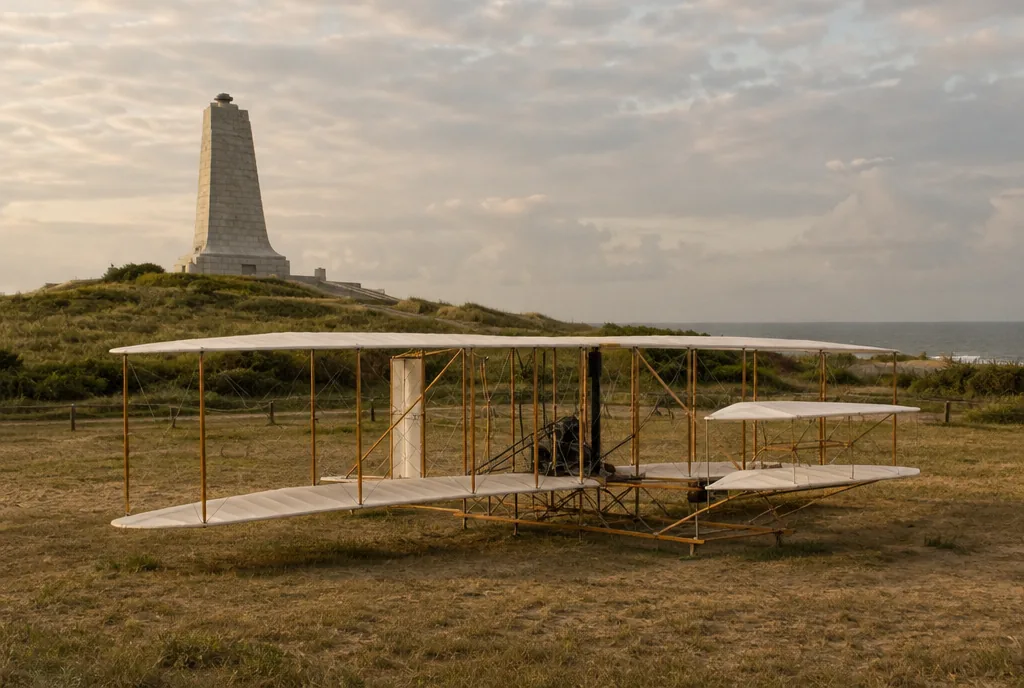
The Experimental Aircraft Association (EAA), with Ford Motor Company as sponsor, ran a touring exhibition called “Countdown to Kitty Hawk.” Its centerpiece was a reproduction of the 1903 Flyer built by Ken Hyde’s Wright Experience in Warrenton, Virginia. Hyde’s team studied the original at the Smithsonian, old photographs and the Wrights’ own notes, and reproduced the wing fabric, engine and propellers as closely as possible. It was the most accurate reproduction attempted up to that time.
Several volunteer pilots trained for months on replica Wright gliders, because the Flyer is hard to control: its forward elevator makes it extremely sensitive in pitch. Kevin Kochersberger, an engineering professor, was chosen to pilot the anniversary attempt.
The pavilion at the memorial
For the anniversary season, a large temporary pavilion went up at the Wright Brothers National Memorial. It housed exhibits on the Wrights’ four years of experiments on the Outer Banks, on the lifesaving station crew who helped them, and on the century of aviation that followed, with artifacts lent by museums and aerospace companies. The structure was designed to be removed after the celebration; the permanent visitor center, opened in 1960, stayed in use and was later renovated.
December 17, 2003: rain, crowds and no wind
The day began with heavy rain and weak, shifting winds. Spectators filled the grounds and the hills around the memorial. President George W. Bush spoke in the morning, praising the Wrights’ persistence and the American aviation tradition that followed. Military and historic aircraft flew over the site, and astronauts and aviation pioneers were among the guests.
At 10:35 a.m. the replica’s engine ran up and the Flyer started down its rail. It lacked the headwind the Wrights had enjoyed, and without that wind it could not reach flying speed on the short track. It ran off the end of the rail and settled into a puddle. A second attempt in the afternoon was called off because conditions did not improve.
The crowd was disappointed, but historians drew a clear lesson. In test flights before the anniversary, the replica had flown when the wind was right. The failure under weak wind showed how close to the limit the Wrights had operated: their machine needed both a strong, steady headwind and an experienced pilot. It also explained why they had chosen Kitty Hawk in the first place.
Where the replica is today
After the centennial, Ford Motor Company donated the Wright Experience Flyer to The Henry Ford in Dearborn, Michigan. It is displayed in the Henry Ford Museum of American Innovation, where it forms the centerpiece of the “Heroes of the Sky” aviation exhibit. The museum also holds the Wright brothers’ home and bicycle shop, moved from Dayton to Greenfield Village in the 1930s.
Visiting the Wright Brothers National Memorial today
The memorial in Kill Devil Hills is run by the National Park Service and is open all year. Main points of interest:
- Wright Brothers Monument: a 60-foot granite pylon on top of Big Kill Devil Hill, dedicated in 1932, at the spot of the Wrights’ glider experiments.
- Flight markers: a granite boulder marks the takeoff point, and numbered stones show where each of the four 1903 flights landed.
- Reconstructed camp: the hangar and living quarters, rebuilt in 1953 from historical photographs.
- Visitor center: a full-size reproduction of the 1903 Flyer and exhibits on the brothers’ methods.
- First Flight Airstrip: a short runway where private pilots can land for a limited stay.
Every December 17 the National Park Service and the First Flight Society hold a ceremony at the memorial, with a flyover timed for 10:35 a.m.
This site is an independent aviation history publication and is not the former Centennial Commission. For the background to the Wrights’ breakthrough, read our articles on the first piloted flight and the history of the first airplane.
Frequently Asked Questions
Did the replica fly on December 17, 2003?
No. Rain and weak winds kept the Wright Experience Flyer from lifting off at 10:35 a.m., and a second attempt later that day was canceled.
How many people attended the centennial at Kitty Hawk?
About 35,000 people came to the Wright Brothers National Memorial for the anniversary.
Where is the centennial replica now?
In the Henry Ford Museum of American Innovation in Dearborn, Michigan.
Is the memorial at Kitty Hawk or Kill Devil Hills?
The flights took place at Kill Devil Hills, a few miles south of the village of Kitty Hawk. The Wrights used “Kitty Hawk” in their telegrams because it had the nearest post office and weather station.